

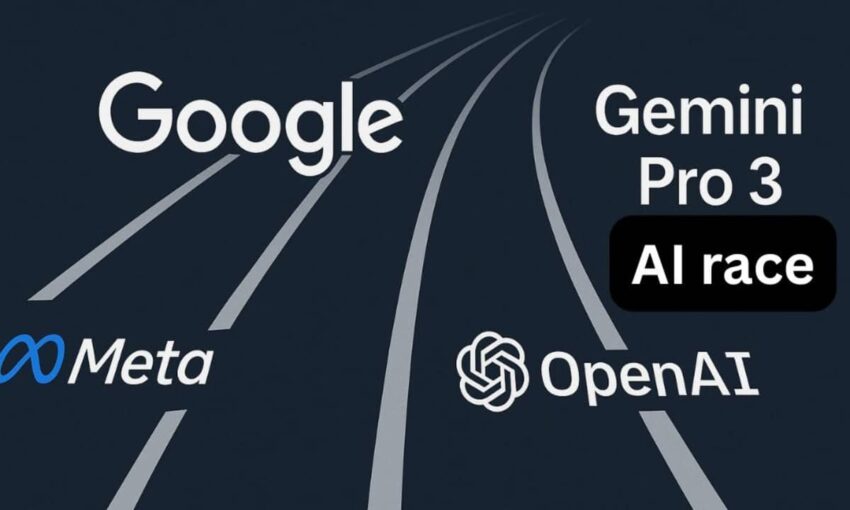
Google has transformed from a cautious observer to a dominant player in the artificial intelligence competition, generating an industry upheaval that has caught even veteran market analysts off guard. The technology giant, previously criticized for sluggish responses, now operates at breakneck speed while fundamentally altering competitive landscapes across semiconductors, cloud computing, and sophisticated model development. It seems the Google AI storm has hit harder than expected.
This momentum shift started when Google released groundbreaking software innovations and established strategic alliances, notably a semiconductor partnership with Anthropic. These actions demonstrated to Wall Street that the company had stopped chasing competitors like OpenAI. Google now drives one of the swiftest and most ambitious expansions the AI industry has witnessed.
The watershed moment arrived with Gemini 3’s debut.
“Google has arguably always been the dark horse in this AI race,” says Neil Shah, who is the cofounder at Counterpoint Research, adding, “It’s a sleeping giant that is now fully awake.”
Industry observers immediately recognized the model’s exceptional reasoning capabilities, rapid code generation, and proficiency in handling intricate, specialized tasks that frequently stump rival systems. This launch positioned Google at the epicenter of the global AI revolution, fortifying its technology ecosystem precisely when worldwide demand for intelligent solutions reaches unprecedented levels.
Google AI acceleration turns the industry on its head
Google’s cloud computing expansion mirrors this upward trajectory. Previously dismissed as a secondary player in cloud services, the company now capitalizes on a worldwide rush toward AI-powered offerings requiring massive computational resources. Growing enthusiasm for Google Cloud stems directly from enterprise requirements for professional-grade AI capabilities, expandable infrastructure, and data-centric operations. Organizations pursuing digital transformation initiatives increasingly migrate to Google’s platform for supporting these advanced functionalities.
Talking to investors in the last quarter, Google CEO Sundar Pichai, mentioned, “We’ve taken a full, deep, full-stack approach to AI. And that really plays out.”
Google AI awakening seems to have sent shockwaves through Silicon Valley. Interest in the proprietary Google AI processors continues to accelerate. These semiconductors have become leading alternatives challenging Nvidia’s hardware supremacy. When media reports indicated Meta was evaluating Google’s chips, Alphabet’s stock prices jumped dramatically. That surge contributed nearly $1 trillion to market valuation since mid-October, representing one of the steepest increases in company history.
Google AI upset rattles rivals

Wall Street has responded decisively. Warren Buffett established a $4.9 billion position in Alphabet during the third quarter, signaling confidence in the corporation’s sustained AI trajectory. Alphabet climbed 1.5% to $323.44 on Tuesday, pushing market capitalization toward $4 trillion.
Broader market reactions proved immediate and substantial. SoftBank Group, a prominent OpenAI investor, plummeted 10% amid mounting concerns regarding Google’s Gemini product strength. Nvidia, maintaining AI chip leadership, declined 2.6%, erasing $115 billion in market value. These abrupt movements highlighted how Google’s revitalized momentum has restructured expectations throughout the entire AI investment ecosystem.
Analyst Neil Shah characterized Google as arguably the dark horse throughout this AI competition. He described the company as a sleeping giant now completely awakened.
Within Google’s leadership ranks, executives have consistently maintained that years of intensive research and substantial internal investment would ultimately yield returns. The organization insisted that deliberate foundational development would safeguard its dominant search position while establishing pathways toward next-generation computing. This approach faced critical examination when ChatGPT appeared, creating the most serious threat to Google’s search monopoly in decades.
Google retained crucial advantages that persisted despite competitive pressure. The company possessed access to enormous data repositories for refining models. It maintained steady profitability, funding ongoing experimentation. And it controlled a worldwide computing infrastructure capable of training and implementing advanced AI at unprecedented scale.
Google AI surge forces a global reset in the chip and cloud wars

The company’s reinvigorated strategy indicates intentions to deploy these assets for aggressive competition. With Gemini 3 gaining marketplace acceptance, cloud expansion accelerating, and chip collaborations multiplying, Google redirects AI market trajectories in unexpected directions. This rapid progression forces competitors to accelerate their development schedules, sparking debates about future AI era dominance.
Google’s evolution from understated competitor to market disruptor illustrates how quickly conditions shift within the artificial intelligence landscape. Once perceived as the organization scrambling to close gaps, it now influences the sector with extensive reach. Industry analysts predict ripple effects will persist as new models, enhanced processors, and additional partnerships materialize throughout 2025.
The technology company’s aggressive pivot reflects strategic decisions made after careful assessment of competitive threats and market opportunities. Google recognized that incremental improvements wouldn’t suffice against well-funded rivals making bold technological claims. The response involved accelerating product releases, strengthening partnerships, and demonstrating tangible capabilities rather than theoretical promises.
Cloud computing revenue streams have become increasingly vital to Google’s AI ambitions. As enterprises worldwide embrace artificial intelligence for operations ranging from customer service to predictive analytics, they require robust cloud platforms offering reliability, security, and scalability. Google positioned its infrastructure as the optimal foundation for these workloads, emphasizing integration between cloud services and proprietary AI tools.
The semiconductor dimension adds another strategic layer. By developing custom AI chips, Google reduces dependence on external suppliers while potentially offering these processors to partners and customers. This vertical integration strategy mirrors successful approaches by competitors who recognized hardware-software synergy as essential for AI performance optimization.
Financial markets interpreted these developments as validation of Google’s long-term vision. The Warren Buffett investment particularly resonated with institutional investors who respect Berkshire Hathaway’s disciplined approach to technology investments. This endorsement suggested Google had achieved sustainable competitive advantages rather than temporary momentum.
Competitive dynamics now reflect Google’s elevated status. Rival organizations must account for Google’s capabilities when planning product launches, pricing strategies, and partnership negotiations. The company’s renewed assertiveness has effectively raised the stakes for everyone pursuing AI market share.
The road ahead

Looking ahead, Google faces challenges in maintaining this accelerated pace while managing risks inherent in rapid AI deployment. Regulatory scrutiny intensifies as governments worldwide examine AI’s societal impacts. Technical hurdles remain as researchers pursue more capable models requiring ever-increasing computational resources. Market expectations continue to rise as investors demand consistent progress, justifying premium valuations.
Nevertheless, Google’s transformation demonstrates how established technology giants can reassert dominance when mobilizing resources effectively. The company leveraged existing strengths—vast data access, financial resources, technical talent, and global infrastructure—to mount a comprehensive AI offensive that reshaped competitive assumptions.
The question now centers on sustainability. Can Google maintain this momentum through 2025 and beyond? Will competitors develop countermeasures neutralizing Google’s current advantages? And how will regulatory and ethical considerations influence strategic options?
What’s your perspective on Google’s AI strategy? Will the company sustain this momentum or face significant headwinds ahead as the Google AI power play redraws the tech battlefield? Please drop your thoughts in the comments below.