


Europe’s AI ambitions are under strain as the continent’s ambitious push to become a powerhouse in artificial intelligence faces an unexpected obstacle: diminishing water supplies.
The European Union announced initiatives this year to expand data center infrastructure threefold over the next five to seven years. Officials aim to position Europe as a dominant force in global AI development. However, the aggressive expansion strategy has sparked concerns about increasing water demands across regions already struggling with chronic water shortages.
Data centers and the hidden cost of AI

Data centers form the foundation of the digital landscape. These massive facilities enable everything from streaming services and cloud storage to cutting-edge artificial intelligence applications. Their operation depends heavily on water-intensive cooling mechanisms to prevent server overheating.
Southern European territories bear particular vulnerability. Nearly 30 percent of residents inhabit zones experiencing continuous water stress, where consumption consistently outpaces natural replenishment. Constructing additional AI computing facilities in these locations intensifies strain on critically limited water reserves.
Nvidia CEO Jensen Huang recently forecasted that Europe’s AI processing capabilities will surge tenfold within two years. More than 20 major infrastructure projects are currently underway across the continent.
Tech giants invest in water-stressed areas
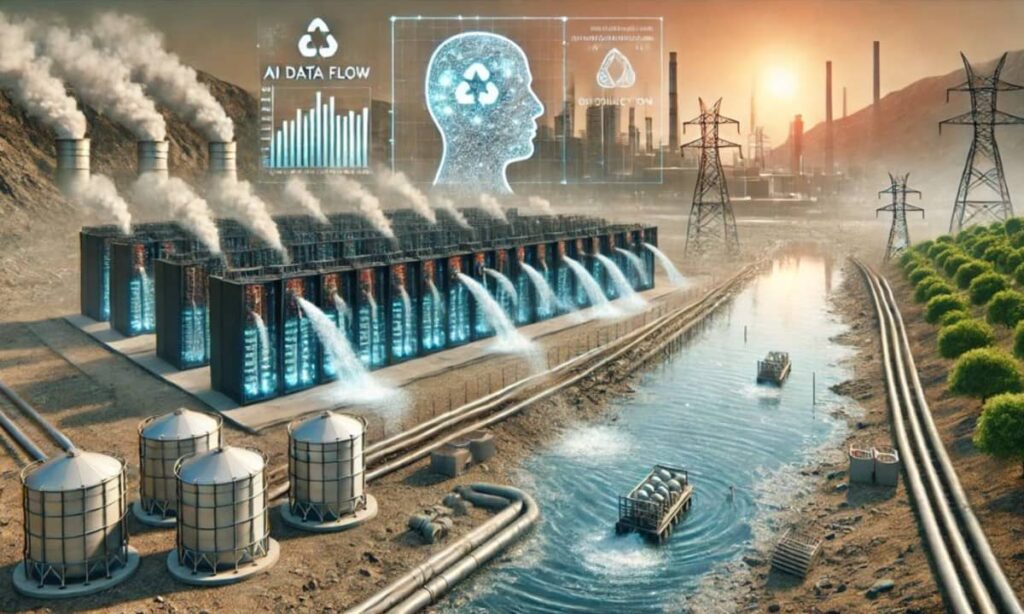
Leading technology corporations are accelerating the buildout. Amazon, Microsoft, and Meta have committed billions toward establishing new data facilities throughout Spain. Google is advancing plans for three computing hubs in Greece’s Attica district.
These corporate investments coincide with prolonged drought conditions affecting multiple European nations. In Spain’s Aragon territory, Amazon’s proposal for three data centers has generated friction between agricultural communities and environmental advocates. In the United Kingdom, officials designated Culham in Oxfordshire as an AI “growth zone,” raising alarm about regional water availability near one of Britain’s first major reservoir projects in recent decades.
Experts question policy planning
Kevin Grecksch, associate professor at the University of Oxford, argues that political figures are pursuing AI development without adequate environmental consideration.
“Artificial intelligence has become trendy shorthand for progress,” Grecksch observed. “National and regional leaders are racing to attract these projects, positioning them as forward-thinking investments that generate employment — yet environmental sustainability appears to be a secondary concern.”
He expressed particular worry about constructing water-dependent infrastructure in Mediterranean climates already experiencing severe aridity.
Brussels promises ‘green computing’
The European Commission maintains that ecological responsibility remains central to its AI infrastructure strategy. A spokesperson referenced the EuroHPC Joint Initiative, which assesses potential facility locations for operational efficiency and environmental consequences.
Officials showcased the “JUPITER” supercomputer in Germany as a model installation. The system operates entirely on renewable electricity and captures waste heat through sophisticated cooling technology for redistribution.
The full water footprint
Experts caution that artificial intelligence’s actual water consumption extends well beyond on-site cooling operations. Nick Kraft from Eurasia Group emphasized that over half of data center water usage occurs during electricity production and microchip manufacturing processes.
“The majority of water consumption happens off-site, embedded in power generation and semiconductor fabrication,” Kraft explained.
Research from S&P Global indicates that southern European nations, such as Spain and Greece, confront the continent’s most severe water stress risks as AI infrastructure proliferates.
Industry pushes sustainability
Trade organizations assert they are advancing sustainable practices. Michael Winterson, secretary general of the European Data Centre Association, stated that facility operators now emphasize water recycling and capture systems.
“Water recycling and harvesting has become standard operating procedure. Ongoing technological advances are reducing energy requirements, minimizing water needs, and nearly eliminating chemical treatment necessity,” he stated.
Winterson defended data centers as crucial economic engines.
“These facilities support trillions in economic output and millions of technology sector jobs throughout Europe,” he said.
He drew comparisons between a 20-megawatt data center’s water consumption and that of a golf course, questioning which delivers greater societal benefit.
Companies are exploring water-free alternatives. Microsoft has experimented with cooling architectures requiring zero water input, while Portugal’s Start Campus utilizes recycled seawater to achieve minimal freshwater consumption.
Mounting pressure from activists
Nevertheless, conservation groups remain skeptical. In the Netherlands, Meta halted plans for an enormous facility in Zeewolde following public opposition regarding water extraction and energy consumption.
Ireland, previously a preferred data center destination, has encountered criticism over facility concentration around Dublin. Both nations have implemented temporary construction moratoriums, citing electrical grid capacity concerns and environmental consequences.
Ireland’s climate and energy ministry supported the industry, emphasizing its economic contributions. Officials noted that most Irish facilities employ air-based cooling, which demands significantly less water than liquid cooling systems prevalent in warmer climates.
A deepening water crisis
The European Environment Agency recently issued warnings that one-third of Europe’s population and territory endure “extreme stress” from water scarcity. Climate scientists predict that Europe’s AI ambitions and artificial intelligence expansion will accelerate this deterioration.
Laura Ramsamy from Climate X stated that establishing hyperscale computing centers in drought-affected territories is “significantly worsening existing conditions.”
Europe, currently the planet’s most rapidly warming continent, faces competing demands: constructing an economy powered by artificial intelligence while protecting irreplaceable water resources.
How Europe reconciles technological ambition with environmental preservation will shape the continent’s AI trajectory for decades.
What’s your take on Europe’s AI ambitions? Should water-scarce regions host data centers, or must sustainability take priority over technological growth?
Please share your views below.