

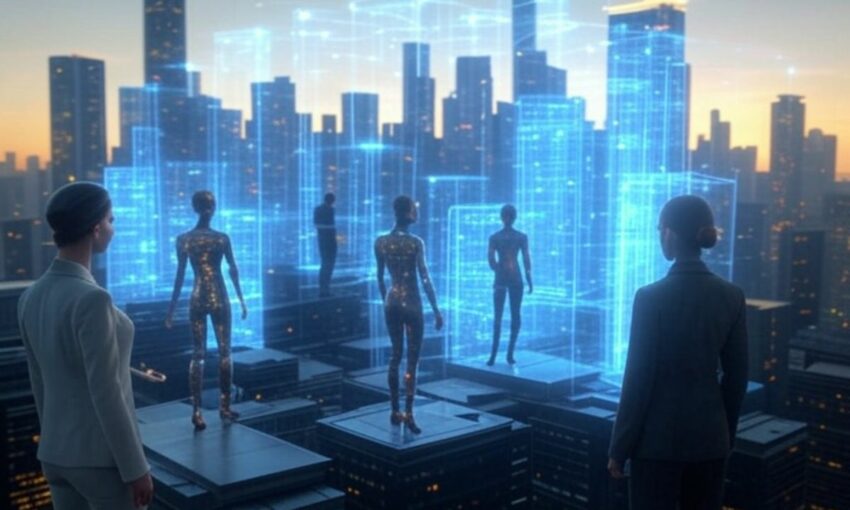
Autonomous AI agents and digital twin technology have moved from experimental concepts to critical business assets in 2025, reshaping industries from manufacturing to urban planning and creating unprecedented opportunities for innovation, efficiency, and competitive advantage.
The convergence of these two technologies—intelligent software entities that can operate independently and virtual replicas that mirror physical systems—is unlocking new capabilities. Nobody could imagine this three years ago, according to industry experts and recent implementation data.
Digital replicas become a business necessity
Nearly 75% of Fortune 500 companies now employ digital twin technology in some capacity, according to the latest Digital Transformation Index published by Forrester Research in February 2025. This represents a dramatic increase from just 23% in 2022.
“We’ve crossed the threshold where digital twins have transformed from competitive advantage to operational necessity,” said Dr. Elena Rodriguez, Chief Digital Officer at Industrial Systems International. “Organizations without this capability increasingly find themselves at a significant disadvantage in terms of efficiency, predictive maintenance, and strategic planning.”
Walmart’s ambitious digital twin implementation exemplifies this trend. The retail giant has created virtual replicas of more than 2,100 store locations—up from the 1,700 reported in earlier implementations—allowing the company to test layout changes, traffic patterns, and inventory placement virtually before implementing physical modifications.
“The return on investment has been extraordinary,” said Marcus Thompson, Walmart’s VP of Store Operations. “We’ve reduced remodeling costs by 42% while increasing sales per square foot by 18% in optimized locations. The digital twins pay for themselves within months.”
The technology extends far beyond retail applications. Singapore’s comprehensive city digital twin project has evolved into what urban planners now consider the gold standard for smart city management. The system integrates real-time data from thousands of sensors, cameras, and connected devices to create a living, breathing virtual model of the entire urban landscape.
“We can now simulate the impact of everything from transportation changes to extreme weather events before they happen,” explained Dr. Wei Chen, Director of Singapore’s Smart Nation Initiative. “This capability has transformed our emergency response planning and infrastructure development processes.”
From assistants to autonomous decision makers
While digital twins provide the virtual environment, AI agents increasingly serve as autonomous operators within these systems. Unlike traditional software that follows rigid instructions, these agents leverage advanced machine learning to understand context, adapt to changing conditions, and make independent decisions.
A January 2025 report from Gartner indicates that 62% of enterprise companies now deploy some form of autonomous AI agents, up from just 14% in 2023. Applications range from customer service and logistics optimization to complex manufacturing processes.
“The key evolution has been the transition from AI assistants that augment human work to genuinely autonomous agents that can handle entire workflows without intervention,” explained Dr. Samantha Williams, AI Research Director at Microsoft. “This shift fundamentally changes the human-machine relationship in business contexts.”
A dramatic illustration of this capability comes from Tesla’s manufacturing operations, where AI agents now oversee production line optimization. The system makes real-time adjustments to manufacturing parameters based on data from hundreds of sensors, resulting in a 28% improvement in production efficiency and a 15% reduction in quality control issues since implementation in late 2024.
“The agents continuously learn from operations data to identify patterns and opportunities that would be impossible for human operators to detect,” said Robert Jackson, Tesla’s Director of Manufacturing Intelligence. “They’ve identified process improvements that our engineers never considered.”
Compelling multiplicative benefits
The integration of AI agents with digital twin technology represents more than the sum of its parts, creating capabilities that neither technology could deliver independently.
In healthcare, this convergence is producing particularly compelling results. Massachusetts General Hospital has implemented a digital twin of its emergency department, complete with AI agents that simulate patient flow, resource allocation, and treatment decisions.
“The system allows us to test process changes in a virtual environment before implementing them with actual patients,” explained Dr. Jessica Martinez, Chief Innovation Officer at Mass General. “We’ve reduced average wait times by 31% and improved critical care response times by identifying and addressing bottlenecks we didn’t even know existed.”
The hospital’s digital twin integrates with electronic health records and real-time monitoring systems to create an accurate representation of current conditions, while AI agents simulate different operational scenarios to identify optimal staffing levels, resource allocation, and patient routing.
Similar applications have emerged across multiple sectors:
Automotive Manufacturing
BMW’s Munich plant employs digital twins with integrated AI agents to optimize production lines in real-time, reducing energy consumption by 24% while increasing throughput by 17%.
Urban Infrastructure
Chicago has developed a digital twin of its water management system with AI agents that predict and respond to potential flooding events, reducing flood damage by an estimated $42 million during severe weather events in 2024.
Energy Grids
The California Independent System Operator (CAISO) employs digital twins and artificial intelligence agents to optimize energy distribution across the state’s power grid, increasing renewable energy utilization by 23% and reducing brownouts during peak demand.
Vatican’s digital preservation expands to cultural heritage sites
Building on earlier work with St. Peter’s Basilica, the Vatican has expanded its digital twin initiative to include the Sistine Chapel and several historical archives. This comprehensive digital preservation project, developed in partnership with Microsoft, serves multiple purposes beyond mere documentation.
“The digital twins capture these irreplaceable cultural treasures in unprecedented detail,” said Cardinal Giuseppe Rossi, who oversees the Vatican’s digital initiatives. “But more importantly, they help us preserve these sites by identifying subtle changes in structural integrity, environmental conditions, and visitor impacts that might otherwise go unnoticed.”
AI agents integrated with these digital twins continuously analyze data from environmental sensors, structural monitoring devices, and high-resolution imagery to detect potential conservation issues before they become visible to the human eye. The system recently identified early signs of microbial growth on a section of ceiling fresco, allowing conservators to intervene before any visible damage occurred.
This approach has inspired similar efforts worldwide, with UNESCO now coordinating a global initiative to create digital twins of endangered cultural heritage sites, including Angkor Wat in Cambodia and Machu Picchu in Peru.
Manufacturing leads adoption curve
Manufacturing remains at the forefront of AI agent and digital twin integration, with implementation rates significantly higher than other sectors. According to the latest research from Andover Intel published in January 2025, manufacturing enterprise adoption of digital twins has reached 84%, with 72% of those implementations now incorporating some form of AI agent technology.
“Manufacturing offers a perfect use case for these technologies,” explained Thomas Williams, manufacturing technology analyst at Andover Intel. “The combination of physical equipment, complex processes, and extensive instrumentation creates an ideal environment for digital twins, while the clearly defined operational parameters make it suitable for AI agent automation.”
GE Aerospace exemplifies this trend with its “Factory of the Future” initiative. The company has created comprehensive digital twins of its jet engine manufacturing facilities, with AI agents that continuously optimize production parameters based on quality outcomes, material properties, and equipment performance.
“The system can detect patterns across thousands of variables that would be impossible for human operators to identify,” said Elizabeth Chen, GE’s Director of Digital Manufacturing. “When we implement agent-recommended process changes, we typically see quality improvements of 15-30% and efficiency gains of similar magnitude.”
Ethical and practical challenges persist
Despite rapid adoption, significant challenges remain in implementing these technologies effectively and ethically. Privacy concerns, data security, and questions about the impact of automation on employment continue to shape the conversation around AI agents and digital twins.
“The data requirements for comprehensive digital twins raise legitimate privacy concerns,” noted Dr. James Wilson, Director of the Technology Ethics Center at Stanford University. “When these systems model public spaces, healthcare facilities, or workplaces, they inevitably capture information about individuals who may not have explicitly consented to this monitoring.”
Regulatory frameworks are still evolving to address these concerns. The European Union’s Digital Twin Governance Framework, implemented in late 2024, represents the most comprehensive approach to date, establishing standards for data collection, privacy protection, and transparency in digital twin implementations.
Technical challenges also persist, particularly around computational requirements and data integration. Creating and maintaining accurate digital twins requires substantial computing resources and sophisticated data management capabilities that remain beyond the reach of many smaller organizations.
What’s in store?
Experts predict four major developments for AI agents and digital twins through 2026: digital twins will connect across companies to model entire supply chains; AI agents will make more independent decisions, especially when speed is critical; cloud services will bring these technologies to smaller businesses; and governments will create more comprehensive regulations addressing ethical concerns.
As these technologies move into mainstream business use, successful organizations will need both technical capabilities and responsible governance frameworks. This evolution is expected to fundamentally change how businesses operate across all industries.
Are you seeing these technologies transform your business operations, or are you still evaluating their potential? Share your thoughts on which of these trends will have the biggest impact on your organization in the coming year.