


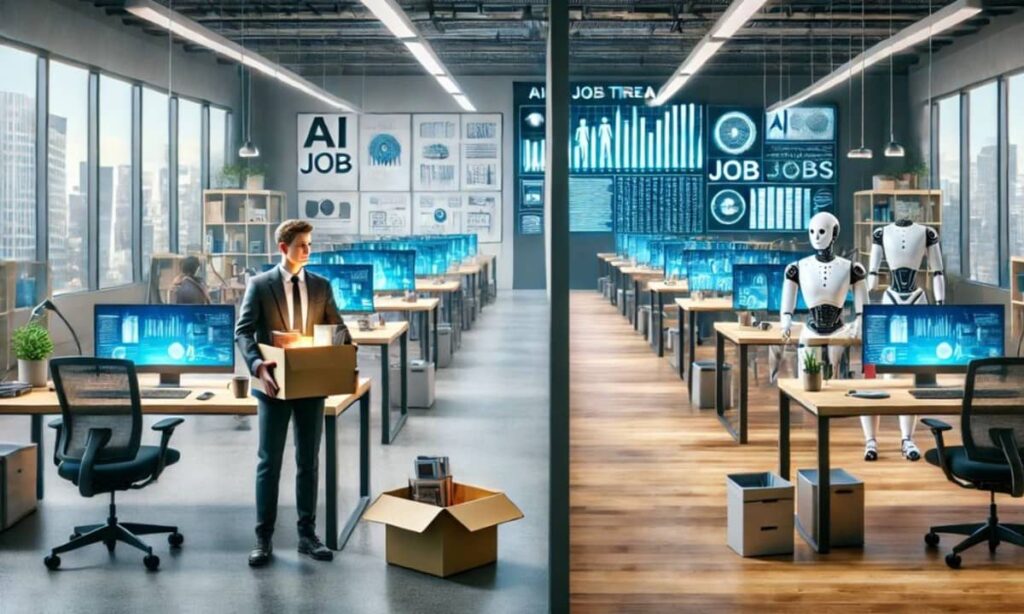
The latest trend in corporate America has a familiar ring: blame the robots. Companies from Silicon Valley to European boardrooms are slashing jobs while pointing fingers at AI. But labor experts say the narrative does not match reality.
A pattern has emerged across multiple sectors. Tech giants, airlines, consulting firms, and language apps all cite artificial intelligence as the driving force behind workforce reductions. The message sounds identical: automation makes these cuts necessary. Employees are not buying it.
The layoff wave wrapped in tech talk

Salesforce eliminated 4,000 customer support positions last September. Management credited its AI system with handling half the workload previously done by humans. Swedish fintech company Klarna reduced staff by 40 percent, crediting automated systems for the efficiency. Language learning platform Duolingo started replacing contractors, stating AI would eventually absorb their responsibilities.
Consulting powerhouse Accenture rolled out a restructuring mandate. Workers who cannot quickly adapt to automation tools face immediate termination. German airline Lufthansa announced 4,000 positions will disappear by 2030 as part of an automation push.
These headlines create a specific impression. Artificial intelligence is wiping out jobs at an unprecedented rate. Workers in every industry now wonder if machines will make them obsolete.
Researchers question the narrative
Fabian Stephany does not accept the corporate explanation. The assistant professor at Oxford Internet Institute studies AI and employment patterns. He told CNBC the layoffs likely stem from different causes entirely.
“I’m really skeptical whether the layoffs that we see currently are really due to true efficiency gains,” Stephany said. “It’s rather really a projection into AI in the sense of ‘We can use AI to make good excuses.'”
Companies may be hiding behind artificial intelligence to appear forward-thinking, Stephany suggested. The real reasons could include pandemic hiring mistakes. Both Duolingo and Klarna expanded aggressively during the coronavirus lockdowns. Now they face corrections.
“There might be various other reasons why companies are having to get rid of part of their workforce,” Stephany explained.
Many firms “significantly overhired” when COVID-19 restrictions boosted digital services. Current cuts represent “market clearance” more than technological displacement.
Industry insiders see through the smoke
Jean-Christophe Bouglé has watched corporate AI adoption from the inside. The Authentic.ly co-founder shared observations on LinkedIn that resonated widely. Real AI implementation lags far behind public announcements, he wrote.
“There’s not much happening,” Bouglé noted. Some companies even reversed artificial intelligence projects due to expenses and data security worries.
Yet layoff announcements keep citing artificial intelligence as justification. “It looks like a big excuse, in a context where the economy in many countries is slowing down, despite what the incredible performance of stock exchanges suggest,” Bouglé wrote.
Worker fears intensify
The disconnect between corporate messaging and reality creates workplace anxiety. Jasmine Escalera studies career trends and organizational behavior. She told CNBC Make It that companies are fueling employee panic through poor communication.
“So we already know that employees are scared because companies are not being honest, open and communicative about how they’re implementing AI,” Escalera said. “Now companies are openly stating ‘We’re doing this because of AI’ so it’s feeding the frenzy.”
Major corporations set workplace standards globally, she warned. Their actions signal what other employers consider acceptable. “Greenlighting bad behavior” creates ripple effects throughout labor markets.
Corporate responses vary
Salesforce pushed back against criticism of its workforce reduction. The company stated its Agentforce AI tool successfully reduced support ticket volumes. Fewer cases meant fewer agents needed. Management emphasized reassignment efforts.
“We’ve successfully redeployed hundreds of employees into other areas like professional services, sales, and customer success,” a company spokesperson said.
Klarna co-founder Sebastian Siemiatkowski addressed the criticism directly on the social media platform X. He clarified that workforce shrinkage from 5,500 to 3,000 employees over two years involved multiple factors. Artificial intelligence played a role, but natural attrition and team consolidation contributed significantly.
Lufthansa and Accenture declined to elaborate on their workforce strategies. Duolingo representatives did not respond to interview requests.
Data contradicts the headlines
Academic research tells a different employment story. Yale University’s Budget Lab recently analyzed U.S. labor market trends since ChatGPT launched in November 2022. Researchers compared current shifts against historical technological disruptions, including computers and the internet expansion.
Their conclusion: artificial intelligence has not triggered significant job displacement. The data shows minimal labor market disruption.
The Federal Reserve Bank of New York published complementary findings in September. Researchers surveyed businesses across the New York-New Jersey region about AI adoption and employment effects.
Results showed widespread AI usage but minimal job losses. Forty percent of service sector companies and 26 percent of manufacturers reported using artificial intelligence tools. Yet layoffs remained rare.
Only 1 percent of service firms eliminated positions due to AI in the previous six months. That figure dropped sharply from 10 percent in 2024. Meanwhile, 35 percent of companies invested in AI-related employee retraining. Another 11 percent actually increased hiring because of artificial intelligence implementation.
Technology panic is nothing new
Stephany placed current fears in a historical context. Anxiety about machines replacing human workers repeats throughout history.
“It reoccurred this century alone a dozen times, you can go back to ancient times where Roman emperors put a hold to certain machines because they were worried about this and always the contrary happened,” he said.
The Internet provides a recent example. Twenty years ago, nobody imagined social media influencers or app developers as viable careers. These professions exist only because technology created new opportunities.
“It allowed for the emergence of entirely new jobs,” Stephany noted. “If you think about the internet 20 years ago, nobody would have known what a social media influencer is, what an app developer is because it didn’t exist.”
The real story behind the spin
Evidence suggests companies use artificial intelligence as a convenient cover for traditional business decisions. Economic slowdowns, hiring overcorrections, and strategic reorganizations drive most workforce reductions. Large-scale technological unemployment remains theoretical rather than actual.
However, corporate communication strategies shape public understanding. Framing layoffs around artificial intelligence deepens worker anxiety across industries. The narrative puts corporate accountability and transparency under increased scrutiny.
Companies face a choice. They can continue blaming algorithms for human resource decisions. Or they can communicate honestly about business challenges and workforce planning. The first approach may seem easier short term but damages trust long-term.
Workers deserve clarity about their employment security. Hiding behind technology buzzwords serves neither employees nor broader economic interests. As artificial intelligence capabilities expand, honest dialogue becomes more critical.
Have you been affected by AI-related layoffs? Do you believe artificial intelligence is truly driving workforce reductions, or are companies using it as a convenient cover for other business decisions? Join the conversation in the comments below and share your experiences with workplace automation.