

Artificial intelligence entered the new year at full speed. What is usually a quiet holiday period delivered clear signs of acceleration, with developments across global markets reshaping the competitive picture. Three forces now drive the narrative. China’s AI advancement shows its move from follower to force.
Physical AI systems are gaining real-world traction. American tech giants are chasing enterprise revenue. Together, these trends signal a fundamental change in how the technology evolves and who leads it.
China moves from follower to force
China’s AI position has undergone a significant shift. Twelve months ago, the nation trailed Western leaders. Today, it shapes pricing models, deployment speed, and market access worldwide.
That transformation is now reaching financial markets. Multiple Chinese AI companies are moving toward public offerings. The list includes Moonshot AI, Z.ai, MiniMax, Biren, and Kunlunxin. The latter is Baidu’s chip division focused on AI hardware.
These IPO preparations reflect growing confidence. Investors and government officials alike believe Chinese firms can thrive despite U.S. chip export limits. The sector has proven resilient and innovative under pressure.
Chinese developers have shifted their focus. They no longer chase Western performance benchmarks exclusively. Instead, they emphasize practical deployment, cost efficiency, and rapid rollout across developing markets.
DeepSeek breakthrough reshapes cost assumptions
One company catalyzed this strategic pivot. DeepSeek released its R1 model with little warning. The launch challenged core assumptions about resource requirements for advanced AI development.
A technical paper followed the release. Founder Liang Wenfeng co-authored the document. It introduced “Manifold-Constrained Hyper-Connections” as a new training framework. The method aims to reduce computing power and energy consumption while maintaining model capability.
This matters significantly in China’s AI context. Access to cutting-edge Nvidia chips remains restricted. Chinese firms must innovate around hardware limitations. DeepSeek’s approach offers a potential path forward.
The impact came quickly. Open access to R1 lowered barriers for developers globally. Engineers across Asia, Africa, and Latin America adopted the technology. Competitors worldwide reconsidered whether computational scale determines artificial intelligence leadership.
Government and capital follow innovation

Chinese policymakers responded swiftly. State support materialized alongside private investment. Valuations climbed across the sector. Funding expanded beyond large language models into embodied intelligence projects.
Robotics companies received new capital. Manufacturing automation startups attracted investors. Logistics platforms integrated AI capabilities. The strategy increasingly favors physical applications over purely digital ones.
This practical orientation defines China’s AI approach. Companies prioritize multilingual support and cultural customization. They build tools for local markets rather than universal platforms. Export products focus on language services, industry-specific software, and automation systems.
The emphasis aligns with broader market evolution. Artificial intelligence is expanding beyond text generation and chatbots.
Physical AI emerges as the next frontier
A new category is gaining attention. Physical AI combines perception, decision-making, and real-world action. These systems power robots, industrial equipment, autonomous vehicles, and smart infrastructure.
Unlike software-only tools, physical AI must navigate messy environments. It handles friction, unpredictable movement, and changing conditions. Proponents view it as the logical progression beyond language models.
Multiple industries are experimenting. Manufacturers test adaptive robotic systems. Warehouses deploy intelligent material handling equipment. Energy companies trial autonomous inspection drones. Market analysts predict this segment will redefine human-machine interaction over the coming decade.
China pursues deployment and efficiency. Meanwhile, American companies are adjusting their strategies.
Meta pivots toward enterprise markets
Meta Platforms is recalibrating its AI approach. After inconsistent progress in recent years, the company is targeting business customers more aggressively.
The acquisition of AI agent startup Manus signals this shift. Meta recognizes that sustainable revenue will come from enterprise adoption. Consumer applications generate buzz. Business tools generate revenue.
Enterprise artificial intelligence automates workflows, manages information, and supports large-scale decision processes. Meta wants to avoid losing ground as competitors deepen corporate relationships. The move represents a strategic repositioning.
Geopolitics reshapes the competitive landscape
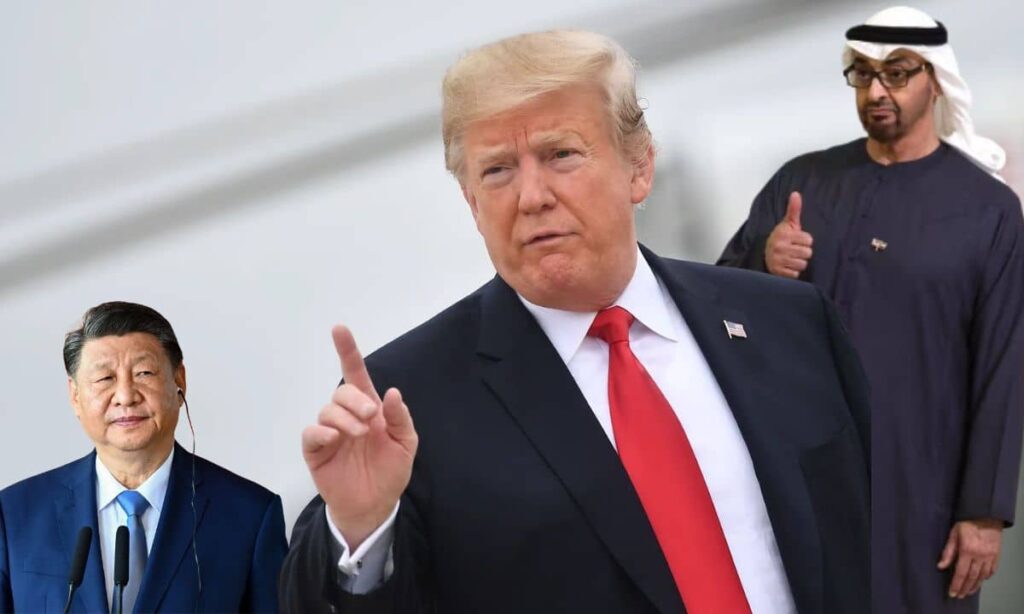
The backdrop extends beyond technology. AI became a major arena of U.S.-China competition throughout 2025. Cooperation diminished. Rivalry intensified.
Export controls tightened. Capital flows faced new restrictions. Supply chains encountered political pressure. Yet these constraints also sparked innovation. Both nations accelerated domestic development in response to external limits.
China emphasized efficiency and quick deployment. The United States invested heavily in infrastructure, software ecosystems, and enterprise platforms. Each approach has distinct advantages.
The divergence may prove defining. Rather than one dominant model emerging, multiple pathways are forming. Some prioritize low costs. Others stress massive scale. Many emphasize market speed above all.
Industry loses pioneering leader
Amid rapid change, the sector mourned a significant loss. Former IBM chief executive Lou Gerstner passed away in late 2025. He earned recognition for transforming IBM during a critical period. His leadership preserved the company’s relevance in enterprise technology.
Gerstner’s legacy highlights an important lesson. Strategic pivots determine which organizations survive major disruptions. His IBM tenure demonstrated how established firms can adapt to technological shifts.
New metrics define success
As 2026 begins, evaluation criteria are changing. AI is no longer judged solely on technical breakthroughs. Deployment scale, operational efficiency, and revenue generation now matter equally.
China’s IPO wave signals commercial maturity. Physical AI’s rise demonstrates practical application. Meta’s enterprise push reflects revenue imperatives. These developments mark a transition toward industrial-scale AI implementation.
The race continues. The competitive landscape remains intense. But the rules governing success are evolving. Technical capability alone no longer guarantees market position.
Looking ahead
The first days of 2026 have revealed the year’s likely themes. Commercial viability will matter more than lab results. Real-world deployment will outweigh theoretical capability. Revenue models will determine competitive standing.
China is betting on efficiency and accessibility. American firms are investing in enterprise infrastructure. Physical AI is moving from concept to reality. Each trend reinforces the others.
The AI industry is entering a more mature phase. Innovation continues at breakneck speed. But the focus has shifted toward practical implementation and business sustainability.
What’s your take on China’s AI development? Please share your perspective in the comments below and let us know which trend you think will have the biggest impact in 2026.