

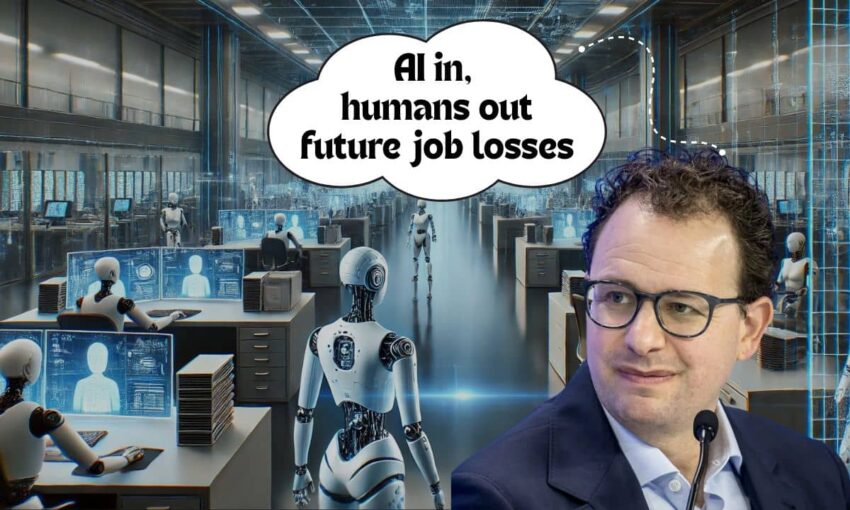
The artificial intelligence revolution threatens to eliminate nearly half of all entry-level professional jobs within the next five years, warns one of the industry’s most prominent figures. Dario Amodei, chief executive of Anthropic, predicts that this massive workplace automation could drive unemployment rates to an unprecedented 20%.
The sobering assessment challenges widespread technological optimism. Amodei’s forecast suggests AI-driven jobs displacement will fundamentally reshape the American workforce faster than most experts anticipated.
“If AI creates huge total wealth, a lot of that will, by default, go to the AI companies and less to ordinary people,” the Anthropic chief explained during recent interviews with CNN and Axios. “It’s definitely not in my economic interest to say that, but I think this is something we should consider.”
This unprecedented warning comes as artificial intelligence capabilities rapidly advance. Major corporations increasingly deploy large language models to automate administrative functions, data analysis, and customer interactions.
Anthropic’s latest Claude 4 system demonstrates near-autonomous operation capabilities, potentially replacing human workers in legal research, financial analysis, technical support, and software development.
Massive disruption of jobs on the horizon, claims Anthropic head
The Anthropic executive’s projections paint a troubling picture of economic upheaval. Current unemployment sits at 4.2%. Amodei anticipates a dramatic quintupling of that figure as businesses embrace AI-powered automation tools.
These intelligent systems already demonstrate superior performance in numerous cognitive tasks. Advanced language models can write code, manage complex workflows, analyze financial datasets, and handle customer communications with increasing sophistication.
“What we’re building is already better than humans at many intellectual tasks,” Amodei stated. “The pace of progress keeps catching people off guard.”
The technology executive emphasizes that artificial intelligence will soon transcend simple task automation. Instead, AI systems will replace skilled professionals whose expertise requires extensive education and training. Entry-level positions serve as crucial career foundation blocks, making their elimination particularly devastating for workforce development.
“Entry-level jobs are vanishing first, and these are the stepping stones for career growth,” Amodei observed.
Government response lags behind technological reality
Despite mounting evidence of impending workplace disruption, political leaders remain largely unprepared for the economic transformation. Amodei describes widespread ignorance among policymakers and business executives regarding AI’s immediate employment impact.
“Most of them are unaware that this is about to happen,” the Anthropic CEO noted. “It sounds crazy, and people just don’t believe it.”
Federal attention has focused primarily on international AI competition rather than domestic workforce protection. The proposed “One Big Beautiful Bill Act,” currently under Senate consideration, would accelerate government AI adoption while preventing state-level regulatory oversight for ten years.
Technology analyst Tracey Follows characterizes current policy approaches as dangerously shortsighted.
“The U.S. is speeding toward mass adoption without guardrails,” she explained. “Amodei’s message is part truth-telling, part market positioning, and part a cry for policy urgency.”
Corporate giants embrace AI-driven workforce reduction
Silicon Valley leaders openly acknowledge accelerating AI integration across their operations. Meta’s Mark Zuckerberg recently predicted artificial intelligence will generate half his company’s software code by the year’s end. Microsoft’s Satya Nadella reports that AI already produces one-third of his organization’s programming output.
Anthropic’s internal data reveals 40% of Claude users currently deploy the system for complete task automation rather than human assistance. This percentage continues to climb steadily.
“AI agents are cheaper, faster, and tireless,” Amodei explained. “Businesses will adopt them en masse the moment they reach human-level effectiveness. That tipping point is months, not decades, away.”
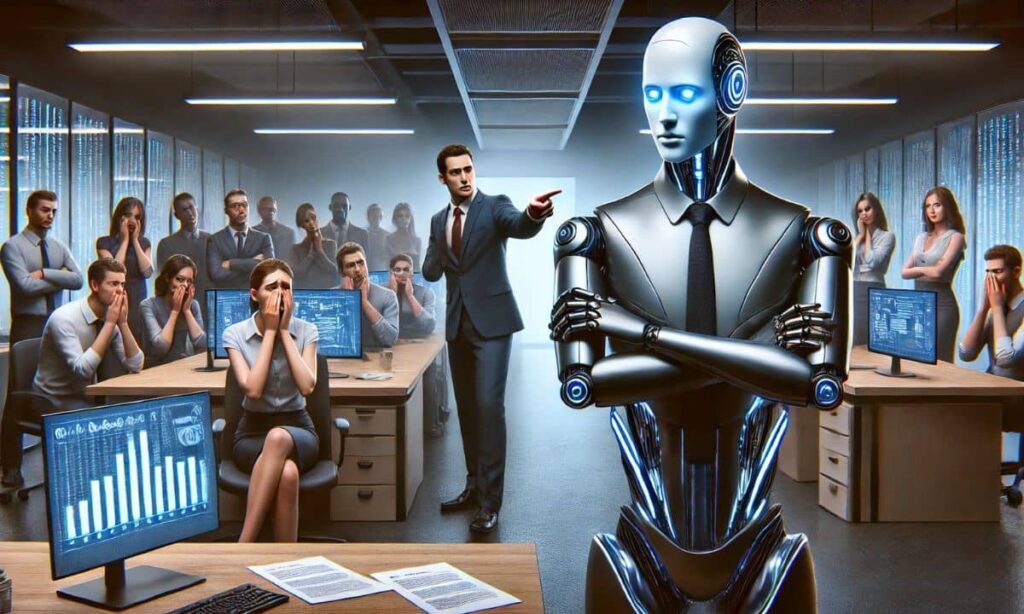
Economic consequences are already materializing across multiple sectors. Microsoft eliminated 6,000 positions recently. Walmart reduced its corporate workforce by 1,500 employees. Cybersecurity firm CrowdStrike cut 5% of its staff, citing AI-driven restructuring initiatives.
Urgent need for policy innovation and workforce protection
The Anthropic leader has proposed specific measures to address the coming employment crisis. His recommendations include implementing an “AI token tax” — a 3% levy on artificial intelligence-generated revenues. These funds could provide economic support for displaced workers.
Amodei also advocates establishing a dedicated congressional committee focused exclusively on AI employment implications. Such oversight would ensure legislators understand automation’s full economic scope.
“This is a conversation we need now—not after the job loss tsunami hits,” he told Fox News. “We can’t stop this train, but we can steer it.”
Anthropic has launched transparency initiatives, including the “Claude Economic Index,” which monitors the model’s cross-industry impact. The company also established an advisory council to guide public discussions about AI’s economic transformation.
Balancing innovation with social responsibility
Despite issuing stark warnings, Amodei maintains optimism about artificial intelligence’s broader potential. He believes the technology could revolutionize healthcare and drive substantial economic growth.
“I wouldn’t be building this technology if I didn’t think it could cure diseases or drive major economic growth,” he stated. However, he acknowledges the inherent contradiction between celebrating technological breakthroughs while warning of mass displacement.
“It’s ironic, I know,” he admitted. “But the least we can do is prepare people. If we manage to just warn them successfully, they’re already a little bit better off.”
Some critics suggest AI executives deliberately amplify disruption fears to increase their technologies’ perceived value. Amodei rejects this characterization while challenging skeptics to consider the alternative.
“If you think we’re exaggerating, ask yourself—what if we’re right?” the Anthropic CEO questioned.
The new economic reality
Artificial intelligence transformation has moved beyond theoretical discussion into immediate reality. Administrative assistants, junior developers, customer service representatives, and financial analysts face imminent automation threats. The employment landscape of 2030 may bear little resemblance to today’s job market.
Preparation time is rapidly diminishing.
As Anthropic’s Amodei emphasized: “The balance of power in a democracy rests on the average person having economic leverage. If we lose that, things become scary.”
The choice facing society is clear: proactive adaptation or reactive crisis management. The window for thoughtful policy responses continues shrinking as artificial intelligence capabilities expand exponentially.
What are your thoughts on AI’s impact on employment? Please share your views below.