

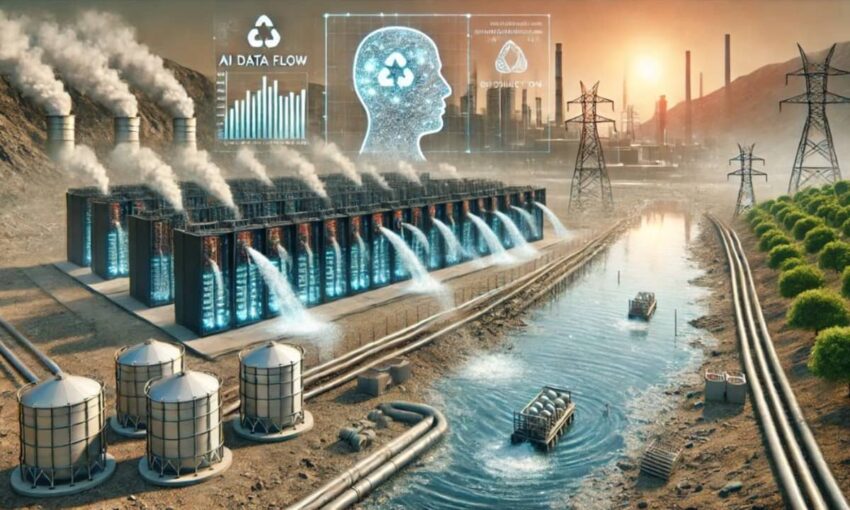
The artificial intelligence revolution is reshaping our world at an unprecedented speed. While public attention focuses on energy consumption and carbon emissions, a critical environmental threat lies beneath the surface: the water appetite of AI.
Machine learning systems aren’t merely software programs running in the cloud. They require substantial physical infrastructure housed in sprawling data centers. These facilities demand massive amounts of water to prevent sophisticated computing equipment from overheating. The scale of this demand is about to reach alarming proportions.
Research indicates that AI-powered data centers across America could consume approximately 720 billion gallons of water each year by 2028. This staggering figure equals the indoor water consumption of roughly 18.5 million American families.
The cooling crisis behind digital innovation
Every ChatGPT query, every AI-generated image, every machine learning task relies on powerful server farms that generate tremendous heat. These computing systems require constant cooling to function properly, and water-based cooling remains the dominant solution. The shift from traditional cloud computing to resource-intensive generative AI has dramatically increased infrastructure demands.
Major technology corporations consumed an estimated 580 billion gallons of water for data center cooling in 2022 alone. Companies like Google, Meta, and Microsoft lead this consumption surge. Unlike household water usage, where most water returns to municipal systems, data centers lose approximately 80% of their water through evaporation processes.
Arizona presents a troubling case study. Google’s data centers extracted enormous water volumes while local agricultural operations failed and communities struggled with water access issues. In The Dalles, Oregon, a single Google facility consumed 25% of the city’s total water supply, with expansion plans still moving forward.
Water-stressed regions become AI hotspots
Bloomberg’s recent analysis revealed that more than two-thirds of new data centers constructed since 2022 were built in regions already experiencing water stress. These locations include Texas, Arizona, and drought-prone areas of California. The pattern extends globally, with new facilities appearing in arid regions of Saudi Arabia, the United Arab Emirates, and northern India.
The water impact extends beyond direct cooling needs. Fossil fuel power plants that supply electricity to AI operations require substantial water for steam generation and cooling systems. This creates an indirect but significant water footprint for artificial intelligence applications.
International Energy Agency data shows that a standard 100-megawatt data center consumes roughly 2 million liters of water daily. This matches the consumption of approximately 6,500 households. Global projections suggest data center water usage could double by 2030, reaching over 1.2 trillion liters annually.
Corporate climate promises fall short
Technology giants have made ambitious environmental commitments. Microsoft pledges to achieve water-positive status by 2030. Google claims carbon neutrality achievements. However, both emissions and water consumption have increased significantly since 2020.
Microsoft’s internal reporting shows a 30% increase in total emissions between 2020 and 2024. Many companies continue using evaporative cooling systems, the most water-intensive cooling method available. Alternative technologies like closed-loop cooling and immersion cooling remain limited and haven’t achieved industry-wide adoption.
The rapid expansion of data center construction has outpaced environmental protection measures. The city of The Dalles filed a lawsuit to prevent Google from keeping water usage data confidential. After a year-long legal battle, the city successfully obtained the consumption records.
Fossil fuel dependencies persist
AI infrastructure remains heavily dependent on fossil fuel energy sources. Chevron has formed partnerships with AI infrastructure developers to construct natural gas power plants specifically for data center operations.
Despite corporate rhetoric about renewable energy adoption, the reality remains challenging. Industry projections suggest only 40% of new data center electricity demand through 2030 will come from clean energy sources. The remaining 60% will maintain substantial carbon and water footprints.
Salt Lake City extended coal plant operations to meet AI-driven energy demands. Arizona utilities increased rates by 8% to cover data center electricity needs, while many rural Navajo communities still lack basic electrical service.
Environmental justice concerns mount

Karen Crawford, leading tech critic and scholar, argues, “We’ve seen that all of the major tech companies building generative AI have increased their water consumption almost up to 40% in a year, threatening the groundwater and drinking supplies of entire towns.”
Disadvantaged communities face disproportionate impacts from AI infrastructure development. Low-income and predominantly Black neighborhoods in Randolph, Arizona, and Memphis, Tennessee, experience increased air and water pollution from AI-related facilities.
Memphis residents report unauthorized turbine operations linked to Elon Musk’s companies, operating without proper permits. These facilities pose health risks, including respiratory problems, cancer, and cardiovascular diseases.
Local families face a double burden. While technology companies receive discounted electricity rates, residential customers pay higher bills to subsidize corporate AI expansion.
Transparency gaps hinder progress
Water consumption data remains largely concealed from public view. Technology companies typically classify this information as proprietary, citing competitive concerns. Only a small number of firms provide detailed water usage reports.
Regulatory oversight faces significant challenges. Texas officials distributed surveys requesting water usage information from data centers. The majority of facilities never responded to these information requests.
Pathways forward require action
Viable solutions do exist within the industry. Some technology firms invest in recycled water systems and watershed restoration projects. Others explore dry cooling technologies and advanced chip designs that reduce thermal output.
However, meaningful progress requires systemic change. Without comprehensive regulation, mandatory transparency requirements, and community-centered decision-making, AI expansion threatens to exacerbate both water scarcity and climate change.
The conversation about AI’s environmental impact must expand beyond electricity consumption. Water resources now represent a critical component of the artificial intelligence equation. Global communities cannot afford to overlook this growing crisis.
What role should local communities play in regulating AI infrastructure development? How can we balance technological innovation with environmental protection? Share your thoughts and experiences in the comments below.