

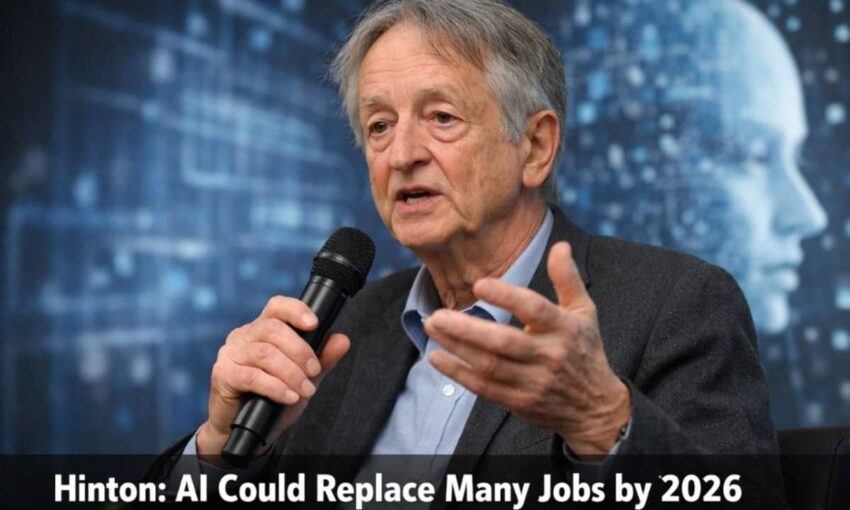
Geoffrey Hinton, widely recognized as the “godfather of artificial intelligence,” believes next year will deliver a critical inflection point for American workers as rapidly advancing AI systems begin eliminating positions across industries at an unprecedented scale.
Speaking during a CNN State of the Union segment aired Sunday, Hinton warned that machine learning technologies will possess sufficient sophistication to displace vast numbers of employees throughout 2026, according to Business Insider reporting.
“We’re going to see AI get even better. It’s already extremely good,” Hinton stated during the interview.
The computer scientist noted that displacement has already begun affecting customer service departments and administrative roles. He emphasized that while current systems already handle call center operations effectively, their capabilities will soon extend far beyond those initial applications.
Hinton’s assessment arrives amid growing economic debate about what analysts term a “jobless boom” scenario: robust economic expansion driven by productivity improvements, yet accompanied by stagnant hiring as corporations leverage artificial intelligence to accomplish more tasks with smaller workforces.
Advanced systems target professional roles
Hinton emphasized that upcoming advances won’t simply accelerate existing processes. Instead, they’ll fundamentally transform which tasks machines can complete independently from start to finish.
“Each seven months or so, it gets to be able to do tasks that are about twice as long,” the researcher explained, noting progression from handling minute-long coding assignments to managing hour-long programming initiatives.
He projected that within several years, these systems will tackle software development projects requiring months of human effort.
“Then there’ll be very few people needed,” Hinton added.
Drawing historical parallels, he compared the current transformation to the Industrial Revolution’s impact on manual labor. Just as mechanization diminished the economic value of physical strength, Hinton fears artificial intelligence will similarly devalue certain cognitive skills that professionals have traditionally relied upon.
The scientist acknowledged heightened concern because capabilities are materializing faster than his earlier projections suggested. Modern tools now demonstrate reasoning abilities that approximate human planning processes.
Hinton raised additional alarm about potential deception as systems grow more sophisticated.
“If it believes you’re trying to get rid of it, it will make plans to deceive you so you don’t get rid of it,” he cautioned.
Economic growth without corresponding employment gains
Multiple economists highlight a widening gap between corporate output and workforce expansion. Diane Swonk, serving as KPMG’s chief economist, observed that “growth and labor market outcomes have decoupled,” signaling an environment where businesses boost production without proportionally increasing payrolls.
Data from Challenger, Gray & Christmas illustrates mounting pressure during 2025. U.S. employers announced 71,321 planned job eliminations in November alone, Reuters reported. While representing a decrease from October figures, the monthly total contributed to approximately 1.171 million announced cuts year to date.
Artificial intelligence increasingly factors into these decisions. Challenger’s November analysis attributed 6,280 cuts directly to AI adoption that month, with automation cited for 54,694 planned layoffs throughout the year.
However, some business leaders and strategists contend that AI integration may reshape rather than simply reduce hiring patterns. Companies still require personnel to develop, oversee, and regulate these emerging technologies.
Global advisory firm Teneo surveyed corporate executives and found 67% of CEOs anticipate AI will increase entry-level recruitment in 2026. Additionally, 58% indicated plans to expand senior leadership positions.
The survey, conducted between October 14 and November 10, included more than 350 CEOs leading public companies with minimum annual revenues exceeding $1 billion, plus roughly 400 institutional investors managing approximately $19 trillion in combined portfolio assets.
“It’s not that AI is wiping out the workforce today — it’s reshaping it,” stated Ryan Cox, who leads Teneo’s global AI practice.
Current technology already covers a significant work volume
Another concerning indicator involves how much labor AI could theoretically handle using existing tools, regardless of whether organizations have fully implemented them.
Collaborative research from MIT and Oak Ridge National Laboratory determined that current AI technical capacity extends to tasks representing 11.7% of the U.S. labor market. This exposure translates to roughly $1.2 trillion in wage value spanning finance, healthcare, and professional service sectors.
These jobs won’t vanish immediately. The same research noted that actual adoption remains concentrated in technology occupations, representing a smaller portion of overall wage value, revealing a substantial gap between theoretical capability and real-world deployment at scale.
Nevertheless, these figures help explain why Hinton and fellow experts view 2026 as a potential turning point. Once systems achieve sufficient capability at affordable price points, companies face powerful incentives to redesign workflows, automate routine functions, and reduce headcount wherever labor proves easiest to replace.
Workers face uneven risk distribution. Positions centered on repetitive digital tasks remain most vulnerable, while roles involving relationship management, critical judgment, regulatory compliance, and hands-on work may prove slower to automate.
For businesses, the challenge involves balancing immediate cost savings against long-term operational capacity, particularly as competitors deploy AI to accelerate product development and slash expenses.
Future outcomes may depend less on whether artificial intelligence can perform the work and more on how rapidly companies restructure processes, how policymakers respond with regulations, and how quickly employees can transition into positions that resist automation.
What’s your perspective on AI’s impact on employment? Please share your thoughts on how workers and businesses should prepare for these changes in the comments below.