

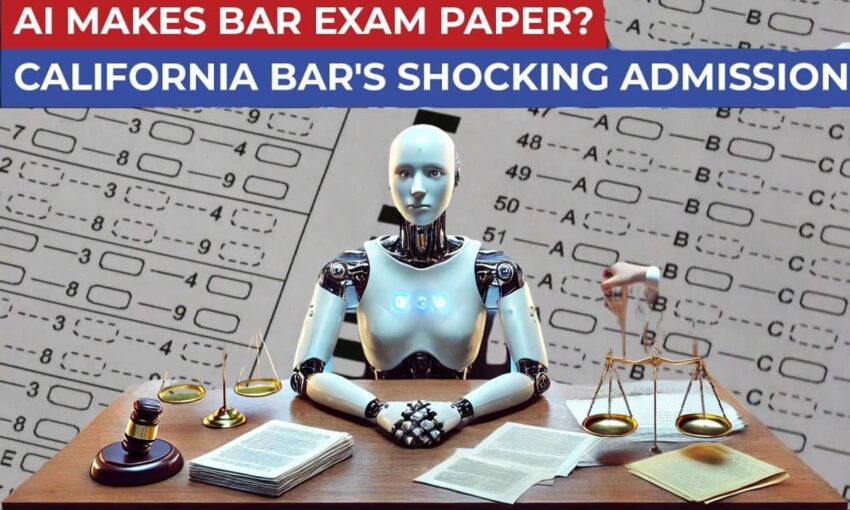
The February 2025 California bar examination faces mounting scrutiny amid allegations of artificial intelligence misuse, widespread technical failures, and a puzzling spike in pass rates. Legal professionals, lawmakers, and exam candidates demand accountability as the situation evolves into a full-blown crisis for the state’s attorney licensing system.
Unprecedented pass rate raises red flags
California’s State Bar recently announced a 55.9% pass rate for its February General Bar Examination. This represents an extraordinary jump from February 2024’s 34% success rate. The figure marks the highest spring passing percentage since 1965.
Rather than celebration, the dramatic increase has triggered suspicion throughout the legal community.
The controversy centers on California’s decision to abandon its longstanding partnership with the National Conference of Bar Examiners. This shift eliminated the traditional 200-question multiple-choice Multistate Bar Examination section. The State Bar instead contracted with Meazure Learning for test delivery and proctoring services, while Kaplan developed new test questions.
Financial concerns partly drove this transition. The State Bar faced a looming deficit in its admissions fund, projected to become insolvent by 2026.
Test-takers describe chaotic experience
“I failed the exam. I’m disappointed because I feel like I wasn’t given a fair shot,” Stephen Zendejas told the California Senate Judiciary Committee.
Zendejas, a first-generation law student, described numerous problems with the exam. He reported malfunctioning features, grammatical errors throughout questions, and confusing prompts that lacked legal clarity or relevance.
The experience has pushed Zendejas to consider leaving California. He has declined a provisional license and the opportunity to retake the exam until fundamental reforms occur.
His sister Tiffany Zendejas, an established public defender who passed a previous version of the exam, expressed dismay at her brother’s situation.
“It makes me feel really sad… in order for him to achieve his dreams, he has to relocate,” she testified.
Senator Tom Umberg directly questioned bar officials during hearings: “There are typos, there are grammatical errors, there were questions that didn’t make sense. How did that happen?”

Legal battle unfolds against testing vendor
The State Bar has filed a lawsuit against Meazure Learning, citing multiple serious allegations. The legal action includes claims of “fraudulent inducement,” “false promise,” “negligent misrepresentation,” and “breach of contract.”
Court documents reveal technology failures plagued even preliminary mock tests. Many candidates reportedly couldn’t access the testing platform, submit answers, or use essential functions during the actual exam.
California’s Supreme Court has intervened, ordering the State Bar to return to its traditional examination format for July 2025. This decision reinstates protocols used consistently for four decades.
Meanwhile, Senator Umberg has introduced Senate Bill 47, which would authorize the California State Auditor to conduct a comprehensive investigation of the February examination.
AI integration raises broader concerns
The controversy extends beyond technical glitches, focusing on artificial intelligence’s role in crafting or influencing exam questions. The situation highlights growing public anxiety about AI’s unregulated expansion into education and professional testing.
Recent polling data confirms widespread concern. A 2025 national survey by Noble Predictive Insights found 64% of registered voters support federal AI regulation. Additionally, 40% express worries about AI-driven job displacement.
“Most people don’t work in AI, so they don’t see any harm in regulating the industry,” explained David Byler, Noble Predictive’s research director. “AI boosters would disagree, but for the average person, regulation only seems to offer protection.”
The comprehensive survey of 2,527 respondents revealed that 33% view AI as potentially threatening humanity’s future. Another 31% acknowledged AI’s capacity to eliminate jobs without necessarily posing existential dangers. Only 13% explicitly opposed regulation, preferring government support for displaced workers instead.
States take initiative on AI governance
The bar exam situation parallels broader regulatory efforts across the United States. According to the National Conference of State Legislatures, 45 states, Puerto Rico, and Washington, D.C. introduced AI-related legislation or resolutions in 2024 alone.
Colorado implemented requirements for high-risk AI system developers to prevent algorithmic bias and enhance user transparency. Florida created grant programs supporting AI integration in educational settings. Indiana established a dedicated task force to explore AI implications.
California’s bar exam problems now serve as a warning about rushing AI implementation in critical professional licensing without proper oversight mechanisms.
Future of legal credentialing at stake
While the State Bar offers failed candidates free retakes and provisional two-year licenses, many like Stephen Zendejas remain unconvinced. Trust in the evaluation system has deteriorated significantly.
Candidates now question whether merit truly determines their assessment outcomes or if technical errors and poorly implemented AI create arbitrary results.
The bar examination has traditionally represented a formidable challenge for aspiring attorneys. However, if future lawyers perceive it as unpredictable, error-filled, or compromised by flawed technology, the legal profession’s credibility could suffer lasting damage.
With July’s examination scheduled to return to familiar formats and public pressure mounting for transparency, California stands at a critical juncture between technological innovation and professional integrity.
Share your perspective below on how AI should be regulated in professional testing. Have you experienced AI-related challenges in your education or career?