

America’s financial markets are experiencing a dramatic transformation in 2025. Artificial intelligence AI investments are reshaping both Wall Street performance and the nation’s economic landscape.
Major technology companies are unleashing unprecedented capital into AI development. This spending surge is creating ripple effects throughout the economy while pushing stock indices to historic levels.
The S&P 500 reached an all-time high of 6,466.58 during Wednesday’s trading session. The benchmark index gained 0.32% and has climbed 10% since January. Market analysts attribute much of this performance to technology sector leadership.
Seven dominant tech corporations are spearheading this investment wave. Their massive AI infrastructure expenditure is generating measurable impacts on national economic growth rates.
The so-called ‘Magnificent Seven’ technology giants are spearheading this investment wave. These dominant corporations have poured hundreds of billions into AI infrastructure development, generating measurable impacts on national economic growth rates
Technology sector investment drives national economic expansion

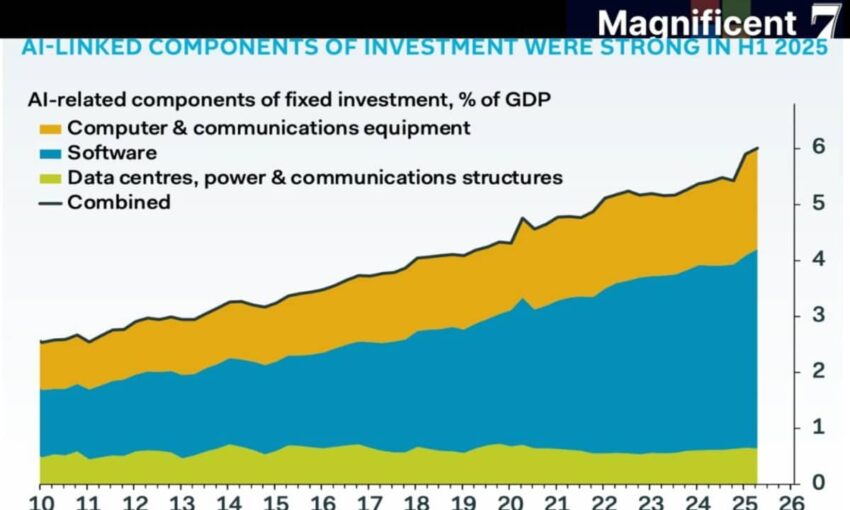
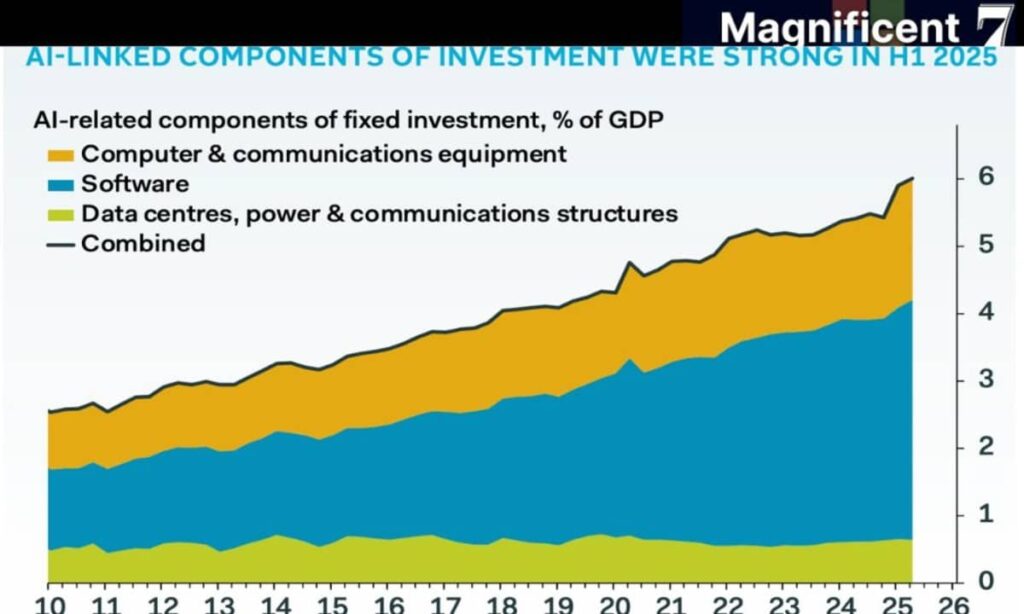
Research from Pantheon Macroeconomics reveals striking data about the economic impact of AI. Economists Samuel Tombs and Oliver Allen calculated that artificial intelligence spending contributed approximately 0.5 percentage points to GDP growth during the first six months of 2025.
This contribution represents a substantial portion of the overall economic expansion. Without AI-related capital expenditures, gross domestic product would have increased at 0.6% on an annualized basis. The actual reported growth rate reached 1.1%.
“Our analysis shows GDP expansion would have been significantly weaker without technology sector AI investments,” the Pantheon researchers noted. “These companies plan continued aggressive spending on artificial intelligence infrastructure throughout 2025 and beyond.”
Market analyst Jens Nordvig supports these findings with similar projections. His research suggests AI capital deployment could boost GDP growth by as much as 0.7% this year.
The scale of this investment surge is remarkable. Pantheon’s data indicates that spending on computing equipment and information technology infrastructure may approach $1 trillion in 2025. This figure demonstrates the extraordinary magnitude of the AI infrastructure buildout across corporate America.
The wall companies — which carry significant weight in S&P 500 calculations — have dramatically increased capital expenditures on data centers, high-performance computing systems, software platforms, and specialized AI hardware components.
Market concentration reaches historic levels amid tech rally
The technology-driven rally has created unprecedented market concentration patterns. Investment strategist Kevin Ford from Convera highlights that the S&P 500’s top 10 companies now control their largest market capitalization share since the 1960s.
“Current market dynamics show the S&P 500’s 10% year-to-date gain stems primarily from mega-cap technology stocks,” Ford explained. “These companies benefit from international revenue exposure and favorable currency movements.”
The scale of this investment surge is remarkable. Pantheon’s data indicates that spending on computing equipment and information technology infrastructure may approach $1 trillion in 2025. This figure demonstrates the extraordinary magnitude of the AI infrastructure buildout driven by the Magnificent Seven and other major technology companies.
Corporate earnings performance has exceeded analyst expectations across most sectors. Approximately 83% of reporting companies have beaten earnings estimates, supporting continued investor optimism about market fundamentals.
Trading patterns suggest investors remain comfortable with current concentration risks. S&P 500 futures showed minimal movement in pre-market activity on Thursday, indicating limited profit-taking pressure despite record-high valuations.
The dominance of major technology companies reflects broader trends in digital transformation and the adoption of artificial intelligence. These firms possess the resources and expertise necessary to capitalize on emerging AI opportunities.
AI spending creates widespread economic multiplier effects

Artificial intelligence investment impacts extend far beyond financial markets into multiple economic sectors. Manufacturing companies are experiencing an increased demand for specialized components required in the development of AI systems.
The expansion of cloud computing infrastructure drives construction activity for advanced data centers. These facilities require sophisticated building materials, energy systems, and cooling technologies that benefit traditional industries.
Semiconductor production has accelerated to meet growing demand for AI-optimized processors. This trend supports employment in high-tech manufacturing and related supply chain industries.
Software development activities are expanding rapidly as companies build AI applications and platforms. This growth creates opportunities for skilled technology workers and supports regional economic development in tech hubs.
Economists emphasize that sustained AI investment levels could provide long-term economic benefits. However, they caution that concentrated growth patterns carry inherent risks if market conditions shift unexpectedly.
International markets show mixed performance patterns
Global equity markets displayed varied performance ahead of U.S. trading sessions. European markets showed modest gains with the STOXX Europe 600 advancing 0.2% in early trading.
The United Kingdom’s FTSE 100 index remained unchanged during morning sessions. British markets continue responding to domestic policy developments and international trade dynamics.
Asian markets presented a mixed picture, with Japan’s Nikkei 225 declining 1.45%. This weakness reflects ongoing concerns about regional economic conditions and monetary policy adjustments.
China’s CSI 300 index showed little movement alongside South Korea’s KOSPI and India’s Nifty 50. These markets are navigating various domestic challenges while responding to global technology sector trends.
Digital asset markets continued their upward trajectory with Bitcoin reaching $121,700. Cryptocurrency prices have generally moved higher alongside traditional risk assets during recent trading periods.
Artificial intelligence maintains position as dominant market theme
Investment professionals broadly agree that AI represents the defining growth narrative for 2025. Technology companies continue signaling their commitment to expanded artificial intelligence investments across multiple business segments.
The sector’s influence on both market performance and broader economic activity appears likely to strengthen. Major corporations are dedicating increasing resources to AI research, development, and infrastructure deployment.
As technology spending approaches trillion-dollar levels, market participants are closely monitoring sustainability factors. The central question involves how long current momentum can persist without requiring broader economic participation from other sectors.
The integration of artificial intelligence into business operations represents a fundamental shift in corporate strategy. Companies across industries are recognizing AI’s potential to drive efficiency, innovation, and competitive advantages.
This technological transformation is reshaping workforce requirements, supply chain dynamics, and customer engagement strategies. The economic implications extend well beyond immediate investment spending into long-term structural changes.
How do you think AI investment will impact your industry or community? Please share your perspective on whether this technology-driven growth benefits the broader economy or creates concerning market concentration risks.