


Artificial intelligence is reshaping the American job market at a pace that has caught business leaders and government officials off guard. New research from the Massachusetts Institute of Technology reveals that AI can already handle tasks performed by nearly 12% of workers in the United States. This latest report about the AI impact on the job market marks the beginning of a transformation that will change how companies function and how careers develop throughout the economy.
The findings suggest a fundamental shift is underway. Jobs across multiple sectors are facing pressure as machine learning systems become increasingly capable. The change affects not just factory floors but office buildings, hospitals, and financial centers where millions of Americans earn their living.
How do researchers measure the AI impact on work?

MIT scientists developed a measurement system called the Iceberg Index to determine how much overlap exists between artificial intelligence capabilities and actual job requirements. The tool examines work patterns of more than 150 million employees across nearly 1,000 different occupations. It identifies where technology matches human skills and where machines can take over tasks immediately.
The analysis spans sectors, including technology, banking, healthcare, and professional services. These industries show the highest levels of exposure to AI-driven change. Vulnerability varies widely depending on the nature of work performed in each field.
Researchers emphasize that their study measures exposure rather than actual job losses. Whether workers lose positions depends on choices made by company executives, public acceptance of automation, and future government rules. Even with that caveat, the data demonstrates that the AI impact extends well beyond software development and digital content creation.
Industries feeling the pressure first
Financial institutions have begun deploying AI systems to handle document processing and assist with data analysis. Healthcare organizations use the technology for administrative duties, freeing nurses and doctors to focus more attention on patient interactions. Manufacturing plants automate quality inspection tasks that workers once completed by hand. Supply chain companies introduce AI tools to manage order fulfillment and inventory tracking.
In each instance, employers test how much of their daily operations can shift to automated systems without compromising the quality of products or services they deliver.
The MIT team evaluated the capabilities of more than 13,000 AI platforms against the skills employees apply in their daily routines. Results show that, in certain roles, technology functions as an assistant. In other positions, it completely transforms how the work gets done.
For example, paperwork processing. AI handles forms at a remarkable speed, allowing the nursing staff to dedicate more time to direct patient care. In software development, the AI impact is more gross. It generates functional code within seconds. This capability forces junior programmers to reconsider their career strategies and skill development.
Entry-level positions face dramatic changes
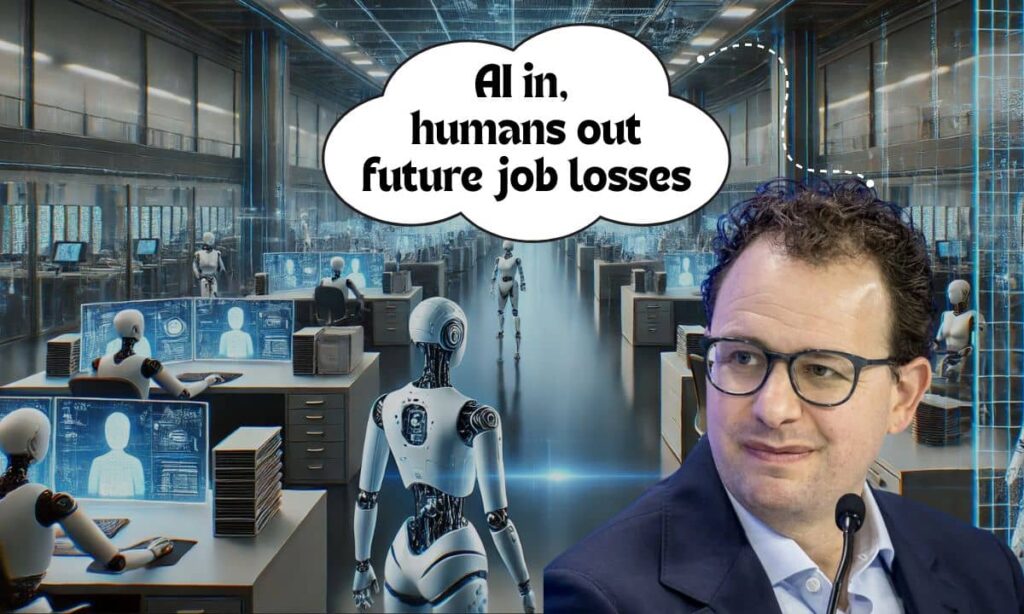
White-collar jobs at the entry level are undergoing significant change. The research notes that AI systems now produce more than one billion lines of computer code every day. This output has prompted companies to rethink their hiring practices and decrease demand for beginning programmers.
These early shifts in technology-related positions indicate a broader workplace reorganization that will extend far beyond the software industry.
Major employers have started taking action. German insurance company Allianz announced plans to eliminate between 1,500 and 1,800 positions in its travel insurance operations over the next 12 to 18 months. AI will replace manual call center functions, according to a source with knowledge of the strategy. The cuts will concentrate on jobs involving repetitive tasks. Allianz Partners, which has approximately 22,600 employees worldwide, stated it is assessing how technological advancement will affect staff levels and conducting private discussions with employee councils.
The scale of potential automation
A fresh analysis from the McKinsey Global Institute presents an even more dramatic picture due to the AI impact. The report states that artificial intelligence and robotics could automate more than half of existing work in America if businesses completely redesign their processes and workflows.
The study estimates that software agents capable of automating non-physical tasks could handle work equivalent to 44% of hours worked in the United States. Robots might manage around 13% of the hours.
This projection does not mean every worker faces displacement. McKinsey stresses that many positions will evolve rather than disappear entirely. People will remain necessary to oversee systems, check accuracy, and manage complex or emotionally sensitive responsibilities.
The report identifies that roles most susceptible to automation represent roughly 40% of all American jobs, especially those in administrative support, legal assistance, transportation, and machine operation.
Which skills survive the AI wave?
Data included in the analysis shows which economic sectors will experience pressure earliest. Non-physical work accounts for approximately two-thirds of work hours in the United States. Many highly automatable tasks span fields, from education and business services to healthcare and legal professions. Work requiring social intelligence or emotional skills remains predominantly human-led.
A key finding indicates that skills will transform rather than vanish. More than 70% of abilities used today appear in both automatable and non-automatable tasks. Communication, management, problem-solving, leadership, customer relations, and written expression remain critical across industries. These capabilities fall in the middle of the automation spectrum. They hold high value, face partial automation, and will likely change as people work more closely with AI-driven platforms.
The surge in AI skill requirements
Demand for AI expertise has climbed sharply. Job listings requiring the ability to use or oversee AI tools have increased seven times in two years. This growth rate exceeds any other skill category. Occupations needing AI fluency now involve about 7 million workers, up from roughly 1 million in 2023.
The economic opportunity is substantial. McKinsey projects that AI-powered agents and robots could create $2.9 trillion in annual economic value by 2030 in America alone. This potential exists only if companies redesign entire processes and workflows, not merely individual tasks. The report showcases major organizations using agents to screen sales prospects, prepare clinical summaries, convert legacy code, and respond to customer inquiries at a dramatically reduced cost.
Consulting firms and banks adjust workforce plans
Even consulting companies feel the AI impact. McKinsey recently eliminated approximately 200 global technology positions as it examines how much additional work AI can absorb. Accenture informed financial analysts in September that budget reductions in Washington might slow its American growth. The firm confirmed it is reducing staff who cannot shift to more automated or AI-aligned roles.
Throughout the banking sector, Bloomberg Intelligence forecasts that as many as 200,000 positions may be cut worldwide over the next three to five years as automation expands. Citigroup believes AI could add $170 billion to the global banking industry by 2028. The bank identifies more than half of the roles as highly susceptible to automation.
What does this mean for American workers?
The research marks a critical moment. Artificial intelligence is already transforming large portions of the workforce, speeding corporate restructuring and raising questions about how millions of employees will adapt to new realities.
The technology may not eliminate most positions outright. However, it is fundamentally changing what those jobs entail and doing so at a speed America has seldom experienced in its economic history.
What are your thoughts on the AI impact on the workforce? Please feel free to share your perspective in the comments below.