

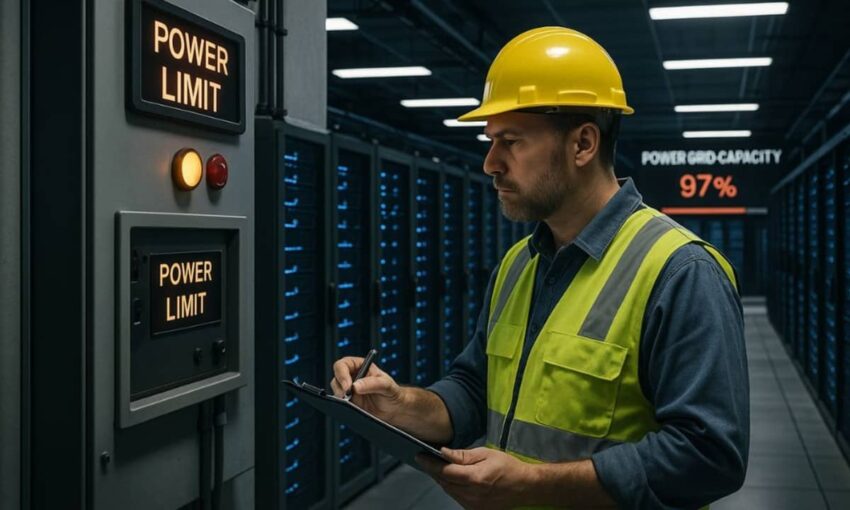
America’s AI giants are locked in an intense battle to control artificial intelligence. Money isn’t the problem. Advanced computer chips are no longer the issue either. The real constraint? Electrical power.
Microsoft CEO Satya Nadella recently spoke with OpenAI’s Sam Altman about the challenges facing the expansion of AI. Nadella revealed that electricity has become the primary bottleneck, not semiconductors.
“The biggest issue we are now having is not a compute glut, but it’s the power and…the ability to get the builds done fast enough close to power,” he explained. He added a stark warning: “So if you can’t do that, you may actually have a bunch of chips sitting in inventory that I can’t plug in.”
That statement reveals everything. AI systems consume vastly more electricity than previous internet technologies. AI giants are no longer racing to design superior processors or secure cutting-edge semiconductors. The competition now centers on accessing sufficient electrical capacity.
Massive spending meets infrastructure reality
Google, Microsoft, Amazon Web Services, and Meta will collectively invest $400 billion in new computing facilities during 2025. That figure will climb in 2026. Wall Street views AI as the next transformative economic force, comparable to the internet boom of the late 1990s. Companies are acquiring property, securing water access rights, and constructing infrastructure faster than any other sector.
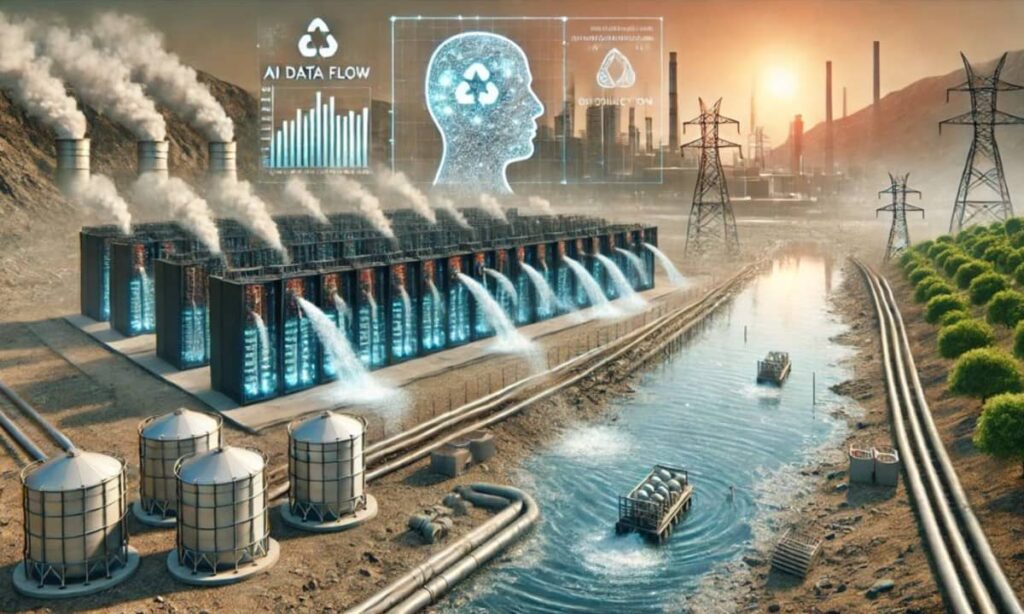
Technology firms accelerated custom processor development to decrease dependence on Nvidia. These specialized chips fill racks inside massive structures resembling industrial warehouses. Some facilities consume millions of liters of water daily for server cooling.
Construction timelines in the United States present serious challenges. Building one data center requires roughly two years. Connecting that facility to high-voltage transmission lines can take a decade. This scheduling conflict is stifling progress.
Energy shortfall hits AI giants

Industry insiders call major technology corporations “hyperscalers.” These companies recognized the emerging energy crisis before most observers. Developers concentrated operations in Virginia, the global hub for cloud computing infrastructure. Dominion Energy received data center requests totaling 40 gigawatts by 2024—equivalent to 40 nuclear power plants.
The demand increased to 47 gigawatts by late 2025.
American households are experiencing rising electricity costs. Current research indicates that data centers consume approximately 4 percent of nationwide power. That proportion could reach 7 percent to 12 percent by 2030.
Some experts question these predictions.
Jonathan Koomey, an energy specialist at UC Berkeley, warned that demand estimates might be inflated. He noted that utilities and technology companies benefit from projecting rapid growth.
“Both the utilities and the tech companies have an incentive to embrace the rapid growth forecast for electricity use.”
Koomey also suggested many announced facilities “will never get built.”
Despite these concerns, industry analysts project a 45-gigawatt power shortage by 2028. That deficit equals electricity consumption for 33 million American households.
Fossil fuels make an unexpected comeback
Soaring demand is testing environmental commitments made over the past decade.
State utilities are postponing coal plant shutdowns. Coal remains the most environmentally destructive energy source globally. Natural gas, which currently supplies 40 percent of global data center power according to the International Energy Agency, is experiencing renewed interest. Gas plants can be constructed quickly and connected to existing grids.
A Georgia utility sought approval for 10 gigawatts of gas-powered generation. Some providers and Elon Musk’s xAI startup are purchasing used turbines from international markets. Others are repurposing aircraft turbines—a specialized solution now becoming standard practice.
Political dynamics add pressure
U.S. Interior Secretary Doug Burgum stated: “The real existential threat right now is not a degree of climate change. It’s the fact that we could lose the AI arms race if we don’t have enough power.”
This creates direct tension between energy policy and national security priorities.
Sustainability goals quietly disappear
Technology companies built public reputations on environmental responsibility. The AI power surge is forcing quiet retreats from those positions.
Google previously committed to net-zero emissions by 2030. That promise vanished from company websites in June 2025. Google replaced specific climate targets with vague references to infrastructure investment.
Rather than reducing emissions, corporations are pursuing alternative power sources capable of delivering large-scale electricity quickly.
Nuclear power and solar energy lead a new approach
The emerging strategy is ambitious. It’s also unproven.
Amazon is backing Small Modular Reactors (SMRs) to revive nuclear power. These compact systems remain experimental but could be deployed faster than traditional reactors.
Google plans to restart an inactive nuclear facility in Iowa by 2029. The Trump administration approved an $80 billion initiative in late October to construct ten large reactors by 2030.
Conventional renewable energy remains relevant. Hyperscalers are funding solar installations and battery systems in California and Texas. Texas anticipates 100 gigawatts of new solar and storage capacity by 2030.
Computing moves beyond Earth
Some AI giants want to bypass terrestrial limitations entirely.
Elon Musk’s Starlink division and Google are developing space-based computing powered solely by solar energy. Google expects initial testing in 2027. Success would represent a major technological leap. Orbital data processing would enhance both capability and security.
Power becomes AI’s defining challenge
The artificial intelligence race is transforming. Innovation isn’t the limiting factor. Talent isn’t holding companies back. Hardware availability has improved.
Electricity is the constraint.
An industry promising to reshape tomorrow faces obstacles from one of humanity’s oldest systems—the electrical grid.
What’s your take on the AI power crisis? Should AI giants slow down, or should governments fast-track energy infrastructure?
Please share your thoughts in the comments below.