

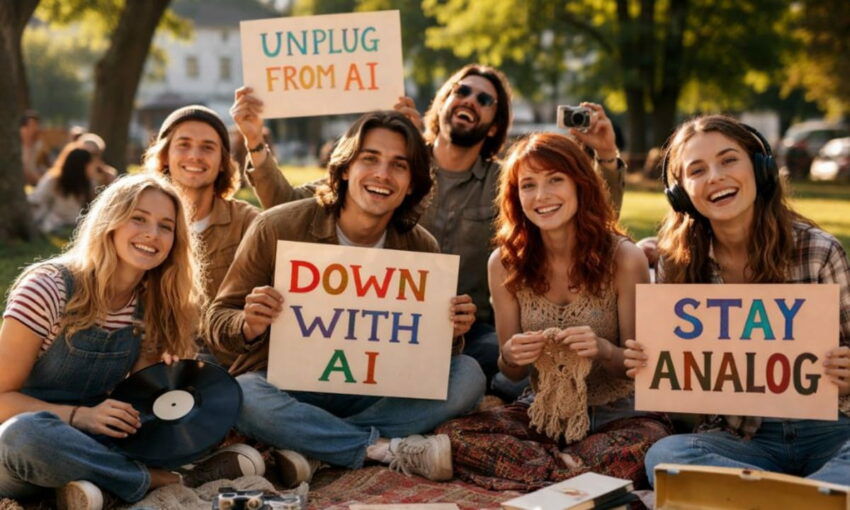
A cultural pivot is underway across America as more individuals deliberately step away from artificial intelligence tools and embrace tactile, offline experiences. This movement toward an analog lifestyle has evolved beyond occasional screen breaks into a sustained lifestyle choice that prioritizes human connection and manual creativity over algorithmic convenience.
The transition represents more than temporary relief from technology. Participants are fundamentally reshaping their daily patterns, selecting physical instruments and slower-paced activities while AI systems increasingly dominate cognitive tasks, planning functions, and creative production.
Quantifying this cultural shift proves challenging, yet market indicators reveal substantial growth. Michaels, the arts and crafts retailer operating over 1,300 locations throughout North America, reports dramatic increases in offline hobby engagement. Website queries for “analog hobbies” surged 136% during the previous six months. Guided craft kit purchases jumped 86% throughout 2025, with projections showing another 30% to 40% climb this year.
Yarn-based products emerged as top performers. Consumer searches for yarn kits exploded by 1,200% in 2025 alone, prompting the retailer to allocate expanded floor space for knitting supplies and similar handicraft materials.
According to Stacey Shively, the company’s chief merchandising officer, customers increasingly view crafting as essential mental health support following pandemic-related stress and endless social media consumption.
“I do think it’s this really big cultural shift happening right now,” she stated.
Toward an analog lifestyle: Testing life without screens
CNN Business reporter Ramishah Maruf investigated this phenomenon firsthand by disconnecting for 48 hours, attempting to replicate 1990s-era living. The experiment required abandoning three iPhones, one MacBook, two desktop monitors, a Kindle device, and an Alexa unit.
While two screen-free days might seem reasonable for many, Maruf confronted powerful impulses to constantly switch between multiple devices.
Before conducting her trial, she interviewed individuals already committed to analog practices.
Contacting Shaughnessy Barker, a 25-year-old Penticton, British Columbia resident, requires dialing her landline phone.
Barker initially joined online spaces as a preteen through Twitter fan communities. Eventually, she observed the internet transforming from a creative playground to a commercial marketplace.
“Everything is meant for profit (on the internet) and nothing is meant to just be for enjoyment anymore,” she explained.
Self-identifying as an “AI hater to my core,” Barker maintains extensive collections of cassette tapes, DVDs, VHS recordings, and vinyl albums, having grown up surrounded by radio and physical music formats. She organizes technology-free craft gatherings, handwrites correspondence, and minimizes computer usage. She purchased an adapter enabling landline service at home and employs a “dumb phone” application during outings.
“If you want to get a hold of me,” Barker informed her social circle, “call me or write me a letter.”
Selective engagement replaces total rejection

Even committed analog advocates acknowledge that complete digital disconnection remains unrealistic. Barker still requires internet access for promoting her vintage merchandise business and “snail mail club” operations.
“I’m a walking oxymoron being like, ‘I want to get off my phone and I’m going to make TikToks about it,'” she admitted.
This paradox permeates the movement. Most participants avoid labeling themselves anti-technology. Rather, they exercise intentional selectivity. Some exchange streaming services for iPod libraries. Others substitute smartphone alarms with traditional clocks or adopt film cameras instead of digital photography.
Avriel Epps, an AI researcher and assistant professor at the University of California, Riverside, identifies exhaustion with generative systems as motivating this shift.
“AI slop is quite fatiguing both in the actual action of viewing the content and the fact that it’s so repetitive, so unoriginal,” Epps observed.
For Epps, an analog lifestyle prioritizes protecting personal data over avoiding information access.
“Going analog is not necessarily about cutting myself off from the information on the internet, but it’s more so about cutting the internet off from the information about me,” she said.
Epps recently abandoned Google’s software ecosystem and maintains screen-free Sundays.
Discovering unexpected benefits

Maruf’s initial offline morning exceeded expectations. She awakened naturally with sunrise, journaled, read “Wuthering Heights” from her bookshelf, and completed morning preparations faster than typical. Without iPod or VHS equipment available, she devoted time to reading and handicrafts.
Her primary discomfort stemmed from perceived performativity. She documented the experience for digital publication and discovered the trend through social platforms. She also selected relatively simple substitutions, like handwritten shopping lists, rather than eliminating family video calls.
Nevertheless, meaningful moments emerged. During a phone-free office walk, she noticed others practicing an analog lifestyle. Tourists paused to appreciate the skyline, drawing her attention upward. On that clear afternoon, the Empire State Building appeared remarkably impressive.
At a weekly Brooklyn library knitting circle, approximately 20 participants across age ranges exchanged stitch techniques and color suggestions without screens. Many described knitting as stress relief.
“Knitting gives you something to do with your hands so you’re not on your phone,” said regular participant Tanya Nguyen.
After two days, Maruf completed substantial novel chapters, mailed a postcard to her 8-year-old cousin, and began learning scarf construction. The time felt concrete. Accomplishment arrived without glowing screens.
Like many millennials and younger adults, she recognized that complete AI rejection wasn’t necessary. She required permission to decelerate. That authorization came through a cultural movement encouraging phone abandonment.
Are you embracing an analog lifestyle or reconsidering your relationship with technology? Please share your experiences and perspective on this growing lifestyle shift in the comments below.