

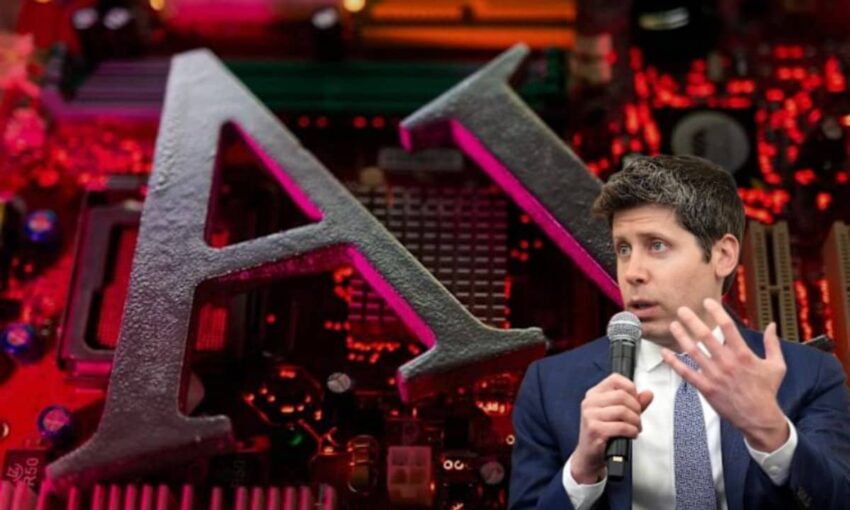
The artificial intelligence gold rush that captivated investors and dominated headlines now faces its harshest reality check. Falling stock prices, failed product launches, and growing doubt show the AI excitement is fading. It won’t be wrong to say that the AI bubble is facing its first real stress test in 2025, as disappointing advances, shaken markets, and rising skepticism challenge years of unchecked hype.
Technology stocks have shed massive value while corporate AI initiatives struggle to deliver promised returns. The enthusiasm that once seemed unstoppable now confronts fundamental questions about AI capabilities versus marketing promises.
Tech giants stumble as bubble fears mount
OpenAI’s leadership faced unprecedented criticism when CEO Sam Altman publicly acknowledged major missteps in launching GPT-5. During a closed-door industry gathering, Altman used terminology that sends chills through any overheated sector: bubble territory.
The admission coincided with devastating research from MIT showing that 95% of enterprise generative AI pilot programs failed to achieve meaningful business outcomes. These findings triggered immediate market reactions across technology sectors.
Wall Street responded with swift punishment. Technology-heavy indices experienced their worst weekly performance in months, erasing more than $1 trillion from the S&P 500 market capitalization. The concentrated nature of AI investments in companies like Nvidia, Microsoft, Apple, and Meta amplified the sell-off impact.
Federal Reserve Chairman Jerome Powell’s Jackson Hole speech provided temporary relief by suggesting potential interest rate reductions. However, underlying concerns about artificial intelligence AI valuations persist among institutional investors.
Veteran critic claims vindication

Gary Marcus has emerged as artificial intelligence’s most prominent skeptic, maintaining since 2019 that machine learning advances were fundamentally overstated. The cognitive scientist and serial entrepreneur now sees his warnings gaining mainstream acceptance.
“I positioned myself as someone grounded in reality who anticipated these exact problems,” Marcus explained to Fortune magazine.
He likened current market dynamics to cartoon physics, where momentum sustains forward motion until inevitable gravitational forces intervene.
Marcus identifies GPT-5’s reception as the crucial inflection point. While acknowledging the model’s technical competence, he emphasized its failure to deliver promised artificial general intelligence breakthroughs.
“Marketing positioned GPT-5 essentially as AGI achievement, which it simply isn’t,” Marcus observed. This disconnect between promotional claims and actual capabilities exemplifies what he considers systematic overestimation of machine intelligence.
The critic argues that anthropomorphizing algorithms leads to unrealistic capability assumptions that inevitably disappoint users and investors alike.
Economic warning signals flash red
Apollo Global Management’s chief economist Torsten Slok intensified bubble discussions through July analysis comparing current tech valuations unfavorably to dot-com era peaks. His research highlighted price-to-earnings ratios and market capitalizations disconnected from underlying revenue fundamentals.
Data center construction spending has reached extraordinary levels, matching consumer expenditure growth that traditionally drives approximately 70% of American economic activity. A Wall Street Journal analysis suggests that infrastructure investments alone contributed as significantly to GDP expansion as household consumption during the early part of 2025.
Former Google CEO Eric Schmidt, previously among the most vocal artificial intelligence advocates, recently moderated his timeline predictions for achieving artificial general intelligence. This rhetorical shift carries particular weight given Schmidt’s influence on Washington policy circles that structured regulatory approaches around assumed AGI inevitability.
Consumer frustration spreads beyond finance
Public sentiment deterioration became evident throughout the summer months, extending well beyond investment community concerns. Brookings Institution research documented declining confidence among both scientific communities and general consumers regarding AI capabilities.
Fast Company publications warned of approaching “AI slop” epidemic, while Axios reported widespread adoption of “clunker” terminology to describe failed artificial intelligence implementations. These linguistic developments reflect growing user dissatisfaction with automated systems.
Consumer experiences with malfunctioning chatbots and error-prone automation tools reinforced credibility concerns. Technologies previously marketed as revolutionary now risk reputation damage from reliability issues.
Historical patterns suggest cyclical nature

Financial historians note striking parallels between current artificial intelligence investment patterns and previous technology boom-bust cycles. Financial Times columnist John Thornhill highlighted consistent patterns across major infrastructure revolutions, from railroad expansion through internet buildout phases.
Technology sector capital expenditure reached $750 billion during 2024-2025, with global projections approaching $3 trillion by decade’s end. This spending trajectory mirrors historical infrastructure investment cycles preceding both speculative bubbles and genuine technological transformation.
Economic theorist Carlota Perez’s seminal research on technological revolutions documents recurring phases: initial excitement, excessive investment, market correction, followed by sustainable value creation. The framework suggests artificial intelligence may follow established historical precedents.
Wall Street maintains mixed outlook
Despite mounting concerns, major financial institutions resist declaring comprehensive bubble conditions. Morgan Stanley analysis projects artificial intelligence could generate $920 billion annually in efficiency improvements for S&P 500 companies alone.
UBS acknowledges current “capital expenditure indigestion” while pointing to rapid revenue growth from platforms including ChatGPT and Gemini as evidence of commercial viability. The investment bank suggests monetization speeds exceed previous technology adoption cycles.
Bank of America’s Savita Subramanian characterized ongoing corporate investment as a fundamental “sea change” rather than speculative mania. However, she cautioned that asset-intensive data center construction could undermine traditionally high technology sector profit margins.
“Technology companies historically maintained asset-light business models focused on research and development,” Subramanian noted. “Current infrastructure requirements resemble manufacturing sector capital intensity.”
Valuation mathematics raises red flags
Marcus emphasizes the fundamental disconnect between market valuations and revenue generation across the artificial intelligence AI sector. Nearly 500 AI unicorn companies command a collective $2.7 trillion valuation despite limited demonstrated profitability.
OpenAI, arguably the sector’s most visible representative, reported merely $1 billion in revenue during July while maintaining unprofitable operations. This performance gap relative to market expectations highlights systemic overvaluation concerns.
“Revenue fundamentals simply don’t support current market pricing,” Marcus concluded. He attributes the disparity to what he terms a “gullibility gap” where investors mistake computational processing for genuine intelligence capabilities.
The cognitive scientist suggests entire market segments rest on a fundamental misunderstanding of artificial intelligence limitations. “This systematic miscomprehension drives unrealistic expectations,” he added. “The situation approaches tragic proportions.”
Current market conditions reflect broader questions about distinguishing between legitimate technological advancement and speculative excess in the rapidly evolving artificial intelligence landscape.
Are we witnessing a necessary AI market correction or the beginning of a prolonged winter for artificial intelligence technology? Share your thoughts on whether current skepticism represents healthy realism or excessive pessimism about AI’s transformative potential.