

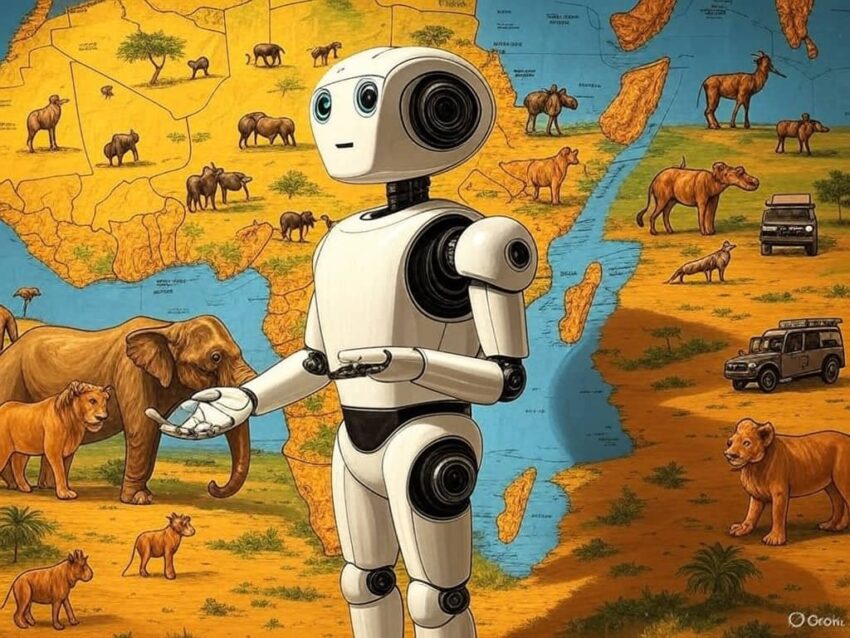
Cassava Technologies announced plans to build Africa’s first dedicated artificial intelligence computing center, marking a watershed moment for the continent’s technological development and digital independence.
The pan-African tech company, founded by Zimbabwean entrepreneur Strive Masiyiwa, will partner with U.S. chip giant Nvidia to install powerful GPU supercomputers across multiple African countries beginning June 2025.
The announcement came just days before the Global AI Summit in Kigali, Rwanda, positioning Africa to join the worldwide artificial intelligence revolution on its terms.
“Our AI factory provides the infrastructure for innovation to scale, empowering African businesses, startups and researchers with access to cutting-edge AI tools without looking beyond Africa to get it,” Masiyiwa said in a statement.
Closing the computational divide
Africa has long faced significant barriers to participating in the global AI boom, with computational resources rather than talent being the primary limitation.
Zindi, an African data science community with more than 80,000 AI practitioners across 52 countries, reports that only 5% of Africa’s machine learning professionals currently have adequate computing resources to conduct serious AI research or model training.
“If you don’t have access to GPUs, it takes you many more hours — if not days — to build the same solutions that would take someone in the U.S. or Europe just hours,” said Alex Tsado, who directs the nonprofit Alliance4AI.
This computational gap has forced African researchers and startups to rely on distant cloud services or abandon ambitious AI projects entirely. The new initiative aims to bridge this divide by bringing high-performance computing directly to the continent.
The first phase will establish GPU clusters in Cassava’s existing data centers across South Africa, Egypt, Kenya, Morocco and Nigeria — countries that represent both regional tech hubs and diverse geographical coverage across the continent.
Democratizing access to AI
Nvidia’s graphics processing units have become the foundation of modern artificial intelligence development worldwide. These specialized chips power many leading AI systems, including those from OpenAI, Google, and Meta, but have remained largely inaccessible within Africa due to prohibitive costs and limited availability.
Research from AI4D, which promotes artificial intelligence for development in Africa, highlights the economic disparities: purchasing a single high-end GPU in Kenya costs approximately 75% of the country’s GDP per capita. Comparatively, these essential AI tools are 31 times more expensive for Kenyans than for developers in Germany.
This cost barrier has forced African innovators to rely on foreign cloud providers, adding expenses through international data transfer fees and suffering from performance issues due to physical distance from servers.
“By establishing Africa-based AI infrastructure, Zindians would benefit from more affordable compute resources, faster access to AI tools, and lower latency — making it easier to develop and deploy AI models efficiently,” said Celina Lee, co-founder and CEO of Zindi.
She added that local GPU access will accelerate AI adoption across sectors from agriculture and healthcare to financial services and education.
“This would democratize AI development, strengthen local AI ecosystems, and drive innovation tailored to Africa’s unique challenges,” Lee said.
Industry analysts predict that local access to high-performance computing could reduce AI development costs by 40-60% compared to using foreign cloud services, potentially triggering a wave of new startups focused on African-specific applications.
Shaping the global AI narrative
The establishment of Africa’s first AI factory represents more than infrastructure development — it offers the continent an opportunity to influence the direction of artificial intelligence itself.
Currently, most large language models and AI systems are built using predominantly Western data, languages, and cultural contexts. This has resulted in AI tools that often perform poorly when applied to African languages, accents, faces, and scenarios.
With local computing resources, African researchers can begin training models on datasets that better represent the continent’s demographic, linguistic, and cultural diversity.
“This will not only reduce AI bias but also give Africa a seat at the table in shaping global AI standards,” said Lee.
Dr. Michael Onyango, technology policy advisor at the African Union, believes this development could help prevent a future where Africa merely consumes AI rather than contributes to its development.
“When we build AI with African data, by African developers, for African problems, we ensure these technologies work for our people and reflect our values,” Onyango said. “Without this, we risk perpetuating digital colonialism.”
Several universities across the continent have already expressed interest in using the new infrastructure to develop AI models that can process Swahili, Amharic, Yoruba, Zulu, and dozens of other widely spoken African languages that remain underrepresented in current AI systems.
Infrastructure challenges remain
Despite the optimism surrounding the announcement, experts caution that significant obstacles must still be overcome.
Electricity supply continues to be one of Africa’s most persistent challenges. Unreliable power grids and frequent outages could potentially disrupt the operation of GPU-powered data centers, which require constant, stable electricity.
“There’s still a big question about how Cassava will overcome energy and infrastructure constraints,” said Tsado.
Cassava Technologies has indicated it plans to supplement grid electricity with solar installations at its data centers, but details about backup systems and reliability measures remain under development.
Additionally, while AI development capacity will be enhanced, end-user accessibility remains limited. Many African consumers rely on basic smartphones with limited processing power and intermittent Internet access, which restricts their ability to use sophisticated AI applications.
Dr. Emmanuel Akyeampong, professor of African studies at Harvard University, suggests that bridging this “last mile” problem will be crucial.
“Building AI is one thing; making it accessible to farmers in rural Tanzania or small business owners in Senegal is another challenge entirely,” he said.
Despite these hurdles, industry experts remain hopeful about the initiative’s potential impact.
“This is a very welcome boost. Africa’s big tech is finally stepping up and investing in local AI infrastructure. Strive’s announcement is the first big public commitment — and it could inspire others,” Tsado said.
Economic ripple effects
Beyond technological advancement, Cassava’s AI factory is expected to generate substantial economic benefits across multiple sectors.
Economic analysts project the initiative could create thousands of new jobs in specialized fields, including data engineering, model deployment, cloud infrastructure management, and AI application development.
The presence of advanced computing infrastructure may also attract foreign direct investment, as international companies seeking to develop AI solutions for African markets could establish local offices to access these resources.
For startups, the reduced cost of AI development could significantly extend their runway and competitiveness. Currently, many African AI startups allocate 30-40% of their operating budgets to cloud computing services, according to the African Development Bank.
“When startups can redirect those funds toward hiring, marketing or product development, we’ll see faster growth and more innovation,” said Tunde Kehinde, founder of Lagos-based fintech Lidya.
Practical applications are expected to emerge in sectors critical to African development, including:
- Agricultural systems that can analyze soil conditions and recommend appropriate crops
- Healthcare diagnostic tools trained on African medical data
- Financial services that can assess creditworthiness without a traditional banking history
- Educational tools that work effectively in low-resource environments
Masiyiwa believes this marks a turning point for African digital sovereignty.
“With this initiative, African innovators will no longer need to send their data — and their ideas — overseas just to make them real,” he said.
The Future
The timing of Cassava’s announcement, coinciding with Rwanda’s hosting of the Global AI Summit, symbolizes Africa’s changing role in the global technology ecosystem.
For the first time, international discussions about artificial intelligence will feature Africa not merely as a beneficiary of foreign technology but as an emerging producer of AI capabilities.
Industry watchers note that this development comes amid growing recognition that the next wave of AI innovation may emerge from previously underrepresented regions with fresh perspectives and unique problems to solve.
“This changes everything,” said Lee. “If done right, it could be the dawn of a truly inclusive, global AI ecosystem — one that doesn’t just happen to Africa, but is built by Africa.”
The first phase of the AI factory is scheduled to be operational by September 2025, with training programs for African developers beginning even earlier to prepare the workforce for these new capabilities.
While significant challenges remain, the initiative represents an important milestone in Africa’s technological journey — one that could potentially reshape not just the continent’s digital landscape but its economic future.
“This isn’t just about having better computers,” Masiyiwa concluded. “It’s about Africa taking control of its technological destiny.”
How do you see Africa’s entry into AI development affecting global technology innovation?
Share your thoughts below on Africa’s tech future!