

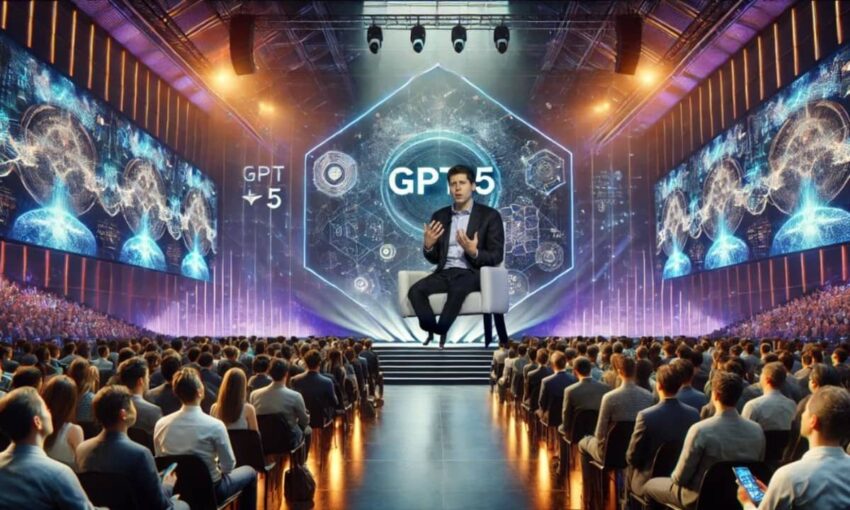
The tech world witnessed another pivotal moment on August 7 when OpenAI CEO Sam Altman unveiled GPT-5 in a presentation that echoed the legendary product launches of Silicon Valley‘s past.
Drawing inspiration from the showmanship that made Apple keynotes legendary, Altman delivered a masterclass in technology unveiling that captured global attention through live demonstrations and compelling narratives about artificial intelligence’s future.
The hour-long presentation, broadcast worldwide, positioned GPT-5 as more than just another AI upgrade. It represents OpenAI’s ambitious vision for bringing sophisticated artificial intelligence directly to mainstream consumers, marking a significant milestone in the democratization of advanced machine learning technology.
Revolutionary All-in-One AI Architecture
OpenAI has fundamentally restructured its approach with GPT-5, consolidating what was previously a complex ecosystem of specialized models into one comprehensive system. The company retired its previous fragmented lineup that included GPT-4o for speed, GPT-4.5 for refined writing tasks, and the powerful o3-pro for coding applications.
This new unified architecture employs intelligent routing to automatically select the most appropriate processing method for each user request. The result is a seamless experience where users access frontier-level AI capabilities without requiring technical knowledge about different model types or their specific strengths.
This consolidation strategy aligns with OpenAI’s broader mission to make advanced AI accessible to everyone. As the company seeks a massive $500 billion valuation in upcoming funding rounds, GPT-5 serves as the cornerstone product that could introduce millions of users to their first experience with truly advanced artificial intelligence systems.
Incremental progress with profound implications
Tech analysts immediately began dissecting GPT-5’s performance metrics, comparing them to existing competitors and previous generations. While OpenAI claims superiority across multiple domains, including scientific reasoning, software development, and complex knowledge work, the improvements are notably incremental rather than revolutionary.
Performance benchmarks show GPT-5 delivering only marginal gains over April’s o3-pro release, which itself represented modest advances beyond last year’s GPT-o1. This pattern suggests the AI industry has entered a phase of steady, methodical progress rather than the explosive breakthroughs that characterized earlier generations.
However, experts caution against dismissing these incremental improvements. Consistent advancement at this pace could produce genuinely transformative systems within a remarkably short timeframe, potentially reshaping entire industries and economic structures.
Tracking the path to artificial general intelligence
Independent research from METR, a specialized AI evaluation laboratory, confirms that GPT-5’s capabilities align precisely with long-term projections for mid-2025. Historical analysis reveals a clear trajectory: GPT-2 in 2019 matched human performance on two-second software tasks, GPT-3 in 2020 handled eight-second challenges, and GPT-4 in 2023 managed four-minute problems.
Current data indicates AI capabilities roughly double every 200 days. Following this trend, GPT-5 now tackles work equivalent to over two hours of concentrated human effort. Extrapolating forward, this progression suggests AI systems could manage full-day white-collar tasks within 24 months.
This timeline carries profound implications for the concept of artificial general intelligence. Many researchers define AGI as technology capable of performing the majority of intellectual tasks that humans can accomplish. If current trends continue, such systems could emerge far sooner than previously anticipated, fundamentally altering our relationship with technology and work.
Growing Calls for AI Governance

The rapid pace of AI advancement has intensified discussions about appropriate regulatory frameworks. Gaia Marcus, who leads the UK’s Ada Lovelace Institute, emphasizes the urgent need for comprehensive policies governing AI deployment and usage across various sectors.
Safety researchers express concern about GPT-5’s enhanced software engineering capabilities. The Future of Life Institute warns these improvements could accelerate “recursive self-improvement” scenarios where AI systems begin developing superior versions of themselves, potentially triggering unpredictable cascading effects throughout the technology ecosystem.
These developments underscore the complex challenge facing policymakers: creating regulatory structures that address legitimate safety concerns while preserving the innovation that drives technological progress and economic growth.
Signaling tomorrow’s AI landscape
Rather than representing a dramatic paradigm shift, GPT-5’s introduction confirms that artificial intelligence development remains on its predicted trajectory. Each successive generation builds methodically on previous achievements, creating increasingly sophisticated, efficient, and user-friendly systems.
The integration of multiple specialized functions into one adaptive platform represents a significant architectural advancement toward more versatile, autonomous AI tools. This approach could become the industry standard, influencing how competitors design their systems and how consumers interact with AI technology.
The broader implications extend beyond technical specifications. With substantial venture capital investments, intensifying competition among major tech companies, and evolving regulatory landscapes, GPT-5’s debut signals the beginning of a more significant transformation rather than a conclusion.
As AI systems approach human-level performance across diverse tasks, society faces critical decisions about integration, regulation, and preparation for a fundamentally different technological future.
What are your thoughts on GPT-5’s potential impact on your industry or daily life? Please share your perspective in the comments below.