

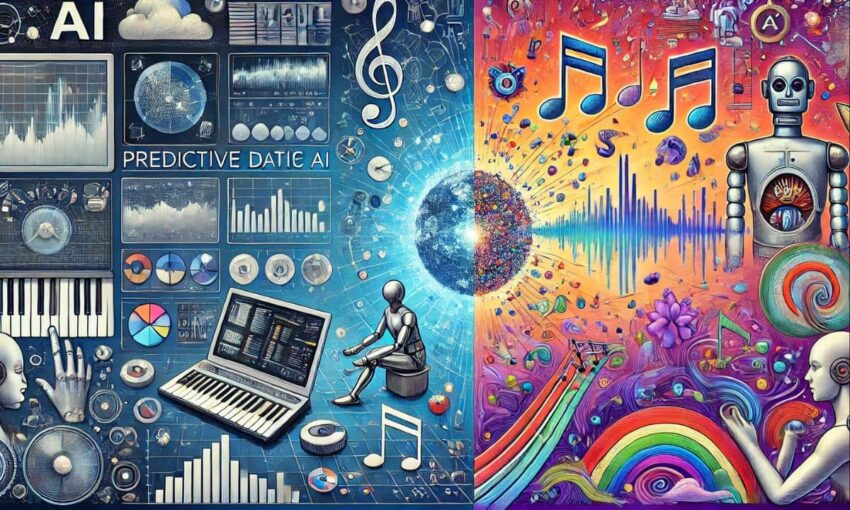
While generative artificial intelligence dominates headlines with ChatGPT and image creation tools, a different branch of AI quietly powers critical business decisions worldwide. Predictive AI analyzes data patterns to forecast outcomes, while generative AI creates original content from learned patterns. These twin forces represent fundamentally different approaches to machine intelligence, each solving distinct challenges as organizations accelerate AI adoption strategies.
Divergent objectives in machine learning
Generative AI focuses on creation – producing fresh text, visuals, music, and code by identifying patterns in massive training datasets. Predictive AI pursues forecasting – examining historical information to generate statistical projections about future events.
“Generative AI aims to perform tasks currently handled by people. In contrast, predictive AI pursues a goal that’s less ambitious but often more consequential: It streamlines an enterprise’s largest-scale operations…while generative AI can appear more impressive and intriguing, predictive AI often delivers greater bottom-line improvements to enterprise efficiencies,” said Eric Siegel, AI author and former Columbia University professor.
The fundamental difference lies in output generation. Generative systems like large language models produce original content resembling their training materials. Predictive algorithms use regression analysis and neural networks to identify patterns and probabilities, delivering insights rather than creative outputs. Both technologies operate under machine learning principles but address separate organizational needs.
Training methodologies and technical architecture

Generative AI processes enormous, unstructured datasets – millions of articles, images, or audio files – to understand human creative patterns. Foundation models with neural network architectures consume raw data and develop capabilities to generate plausible outputs. Post-training fine-tuning optimizes performance for specific applications.
These systems respond to prompts by creating content that appears human-generated, whether composing emails or designing graphics. Core technologies include generative adversarial networks that improve output realism through competitive training and transformer models using attention mechanisms for coherent text generation.
Predictive AI operates through different principles. Training occurs on labeled, structured datasets – years of sales records, patient medical histories, or transaction logs – to identify trends and correlations. Methods include regression analysis, decision trees, and time-series forecasting to understand relationships between historical inputs and known outcomes.
After training completion, these models extrapolate future events from new data inputs. Credit card fraud detection systems analyze transaction patterns, while maintenance prediction models examine equipment usage logs to forecast failures.
Nicholas Renotte, IBM AI engineer, advises strategic selection: “Lots of businesses want to generate a financial forecast, but that’s not typically going to require a gen AI solution, especially when there are models that can do that for a fraction of the cost.”
Application landscape: Innovation meets optimization
Generative AI enables breakthrough creative applications across industries. Large language models power conversational chatbots for customer service and report generation. Image synthesis tools like DALL-E create artwork from text descriptions. Software developers leverage GitHub Copilot for automated code generation.
Healthcare applications include molecular design for drug discovery and synthetic data generation for medical research. Marketing teams deploy generative AI for personalized advertising, social media content, and product design at unprecedented scale. Entertainment industries use procedural content generation for virtual environments and character development.
Predictive AI serves as the analytical backbone for data-driven industries. Financial institutions employ predictive models for market trend analysis and credit risk assessment. Recommendation engines power Netflix and Spotify suggestion algorithms, driving user engagement and retention.
Manufacturing sectors implement predictive maintenance systems, preventing equipment failures and reducing operational downtime. Retail organizations optimize inventory management through demand forecasting, ensuring efficient supply chain operations. Healthcare providers analyze patient data for early disease detection and treatment outcome predictions.
Many platforms integrate both approaches strategically. E-commerce companies use generative AI to create personalized marketing content and then deploy predictive AI to target customers based on purchase history analysis.
Comparative advantages and limitations

Generative AI strengths include creative flexibility and innovation acceleration. These systems produce unexpected designs and ideas, enhancing content production efficiency for open-ended tasks like campaign slogans or product brainstorming. Continuous learning through feedback improves output quality over time.
Generative AI challenges center on accuracy and reliability. Pattern mimicking without factual understanding leads to hallucinations – confident but incorrect information generation. Copyright concerns arise when outputs resemble training data too closely. Neural network opacity makes output explanation difficult, complicating troubleshooting and trust building.
Predictive AI advantages focus on accuracy and decision support for defined problems. Quality data enables pattern detection across massive datasets, often exceeding human forecasting capabilities for sales, fraud detection, or medical diagnosis. Model interpretability allows stakeholders to trace predictions to specific contributing factors.
Predictive AI limitations include data dependency vulnerabilities. Biased or incomplete historical data produces skewed predictions. Hiring algorithms trained on non-diverse workforce data may perpetuate discrimination. These models struggle with unprecedented events or radical market shifts, relying on historical pattern extrapolation.
Ethical challenges and workforce impact

Generative AI ethical concerns encompass authenticity and intellectual property disputes. AI-generated content enables misinformation campaigns and deepfake creation, undermining online content trust. Legal uncertainties surround AI-created content ownership and copyright infringement liability. Training data biases can produce offensive or discriminatory outputs, requiring diverse datasets and content moderation systems.
Predictive AI ethics focus on fairness and transparency in high-stakes decisions. Biased training data creates unfair outcomes in hiring, lending, and criminal justice applications. Historical prejudices embedded in datasets can disproportionately impact specific demographic groups. Companies must implement algorithmic auditing and explainable AI techniques for decision transparency.
Privacy protection becomes critical as predictive systems require extensive personal data collection and analysis.
Workforce implications present both opportunities and challenges. McKinsey research projects that generative AI and automation could generate $2.6 to $4.4 trillion in annual economic value, potentially increasing global productivity by 15-40% in the coming years.
Productivity benefits include AI-assisted customer support and enhanced analytical capabilities, allowing employees to focus on strategic work. However, job displacement concerns persist as predictive AI automates data entry and analysis roles, while generative AI impacts content creation, illustration, and programming positions.
Recent executive surveys predict up to 20% headcount reductions in the supply chain and customer service sectors within three years due to AI adoption.
A Microsoft-Carnegie Mellon University study warns about cognitive dependency risks: “The more you use AI, the more your cognitive abilities deteriorate.” Heavy AI reliance can diminish critical thinking skills and solution diversity. Maintaining balanced human-AI collaboration where technology augments rather than replaces human judgment remains essential.
Strategic importance in 2025
Understanding generative versus predictive AI distinctions carries significant strategic implications beyond academic interest. Choosing appropriate AI types for specific problems determines initiative success or failure. Generative AI excels in creative and unstructured problem-solving scenarios, while predictive AI optimizes data-driven forecasting and planning operations.
Misaligned AI application wastes resources and deliver poor results. Using text generators for inventory prediction yields inadequate outcomes, while specialized predictive models can generate millions in logistics savings.
Regulatory frameworks require different approaches for each AI type. Predictive systems need transparency and audit capabilities, while generative outputs require content moderation and watermarking solutions. Public understanding helps set realistic expectations about AI capabilities and limitations.
Advanced AI deployments increasingly combine both approaches. Generative components handle human interaction and option generation, while predictive elements process numerical analysis. Organizations understand these technological nuances can integrate complementary AI tools more effectively.
Artificial intelligence represents a diverse toolbox rather than a single monolithic solution. As AI transformation accelerates across industries, stakeholders who comprehend the fundamental differences between machines that create original content versus those that analyze future possibilities will innovate most responsibly and effectively in this new intelligence era.
How is your organization balancing generative and predictive AI implementations? What challenges and successes have shaped your AI strategy?
Please share your insights on navigating the evolving artificial intelligence landscape.