

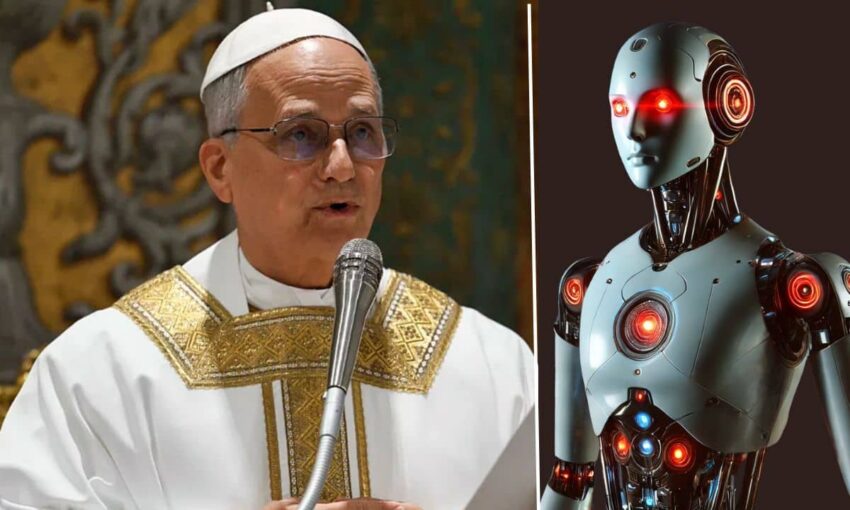
Pope Leo XIV has wasted no time establishing artificial intelligence as a cornerstone concern of his pontificate. The newly elected pontiff highlighted AI’s transformative potential and its ethical challenges during his initial appearances before the faithful.
“We must harness this immense potential for innovation while ensuring it serves the common good,” the Pope declared during his first week in office.
The 21st century’s first Leo staked out his position clearly in his inaugural address. Speaking forcefully to the College of Cardinals, he pledged to tackle “developments in artificial intelligence that threaten human dignity, justice, and meaningful work.” His early emphasis signals AI policy will rank among his administration’s top priorities.
“In our own day, the church offers everyone the treasury of its social teaching in response to another industrial revolution and to developments in the field of artificial intelligence that pose new challenges for the defence of human dignity, justice and labour,” he said.
Grassroots concerns reflect papal priorities
The Pope’s warnings resonate strongly with Catholic communities worldwide. At Berlin’s St. Matthias Schöneberg Church, congregation members increasingly voice digital anxiety. Parents implement social media restrictions on their children’s devices. Educators remain vigilant against AI-enabled academic dishonesty. Schools now offer digital literacy programs. Professional translators fear technological displacement.
Vatican leadership has assembled expertise to address these concerns. Paolo Benanti serves as the church’s principal advisor on technological ethics. The Franciscan friar, who holds a doctorate in tech ethics, praised Leo’s “bold” focus on digital issues.
“His Holiness recognizes the urgency of this moment,” said Benanti, who previously guided Vatican departments on digital life questions. His research focuses specifically on artificial intelligence and human enhancement technologies.
Building on Francis’ digital foundation
The Vatican’s engagement with artificial intelligence didn’t begin with Leo XIV. His predecessor, Pope Francis, repeatedly advocated for responsible AI oversight. In 2024, Francis urged technologists to develop solutions for social challenges rather than pursuing “profit and power.” These pronouncements established groundwork for Leo’s agenda.
Francis’ interventions prompted several church committees to study AI policy implications. He also engaged directly with technology executives to explore digital ethics frameworks.
Historic parallels guide modern response
Leo XIV draws inspiration from his 19th-century namesake. Pope Leo XIII’s landmark 1891 encyclical Rerum Novarum addressed industrial revolution challenges, warning against treating workers as “mere instruments for money making” while acknowledging scientific progress.
The current pontiff sees clear parallels between that era’s disruption and today’s digital transformation. Vatican observers note this historical connection provides moral context for the church’s AI engagement.
“Sensing myself called to continue in this same path, I chose to take the name Leo XIV. There are different reasons for this, but mainly because Pope Leo XIII in his historic Encyclical Rerum Novarum addressed the social question in the context of the first great industrial revolution,” stated the pope.
Technology’s rapid advance outpaces governance
Meanwhile, artificial intelligence development accelerates globally. Tech companies invest billions in research and commercialization. International consensus on regulation remains elusive.
American policymakers view AI leadership as strategically crucial. They resist restrictions that might surrender advantage to geopolitical competitors. Technology corporations increasingly channel research through open-source initiatives. Government agencies struggle to establish effective oversight frameworks.
Promise and peril balance precariously
AI advocates highlight potential benefits in healthcare innovation and economic productivity. Serious risks loom equally large. Synthetic media spreads misinformation at unprecedented scale. Autonomous weapons systems may operate beyond meaningful human control. Algorithmic bias threatens to entrench societal discrimination. Data privacy concerns continue mounting.
Regulatory landscape taking shape
The European Union leads global regulatory efforts. Its comprehensive Artificial Intelligence Act took effect August 1, 2024, following European Parliament approval last March. The legislation categorizes AI systems by risk level and mandates transparency requirements.
Implementation timelines vary. Core prohibitions and digital literacy provisions were activated in February 2025. High-risk systems embedded in regulated products have until August 2027 to comply.
On April 22, 2025, EU authorities released preliminary guidelines for general-purpose AI models. These standards clarify provider responsibilities regarding transparency, accountability, and risk management. Final regulations remain pending.
The international community continues seeking collaborative approaches. The AI Action Summit in Paris this February brought together over 1,000 delegates from 100 nations. French President Emmanuel Macron and Indian Prime Minister Narendra Modi co-chaired discussions on global governance frameworks.
Catholic innovation tradition continues
The Catholic Church maintains a centuries-long relationship with technological progress. Medieval monasteries pioneered tidal water wheels. Early scientific instruments like calculators and barometers received church support. Today’s religious applications extend this tradition.
Modern services include Bible Chat, which charges $59.99 annually for faith-based question answering. Magisterium AI helps clergy select appropriate Mass readings. These applications represent a cautious embrace of AI tools within religious contexts.
Pontiff’s background suits technological challenge
Leo XIV brings relevant expertise to these complex issues. His mathematics degree provides a technical foundation for understanding AI systems. He integrates logical analysis with theological and legal perspectives. His American upbringing potentially facilitates dialogue with Silicon Valley leadership.
Vatican analysts anticipate a comprehensive papal encyclical addressing artificial intelligence by 2031. Observers speculate the document might carry the title “Imago Dei” (Image of God). It would likely establish moral principles for AI governance. The global technology community will closely monitor whether the Pope’s moral authority influences AI’s developmental trajectory.
How is artificial intelligence affecting your work, education, or faith community? Please let us know your thoughts on balancing innovation with human dignity in the digital age.