

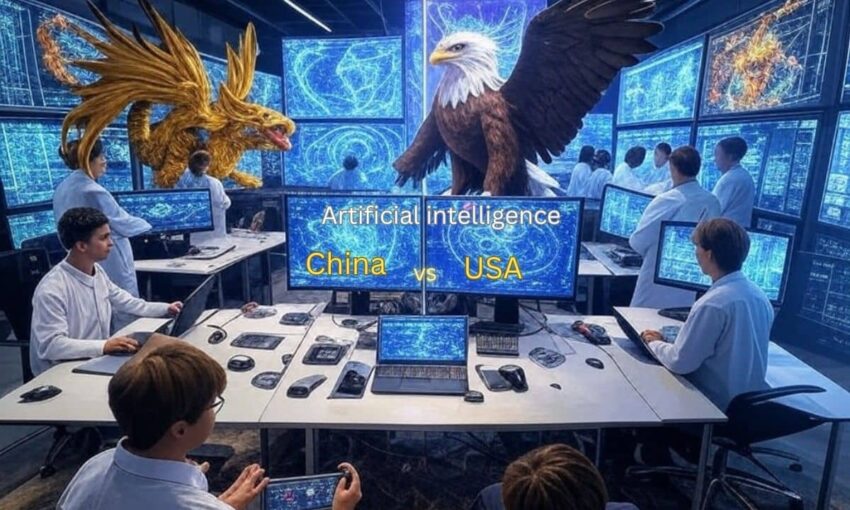
For decades, the United States has stood as the undisputed champion of artificial intelligence innovation, pioneering breakthroughs and establishing benchmarks that have guided global development. This technological hegemony, however, faces unprecedented challenges as international competitors—particularly China—gain momentum with remarkable speed. The shifting dynamics have ignited intense national discourse regarding strategic imperatives necessary to preserve America’s preeminent position in the AI ecosystem.
Emerging competitors in the AI sphere
American dominance in artificial intelligence has been well-documented through objective metrics. A comprehensive 2023 European Union analysis revealed that an overwhelming 73% of large language models originated in the United States, while China accounted for just 15% of global development.
This disparity extends to financial investment as well—Stanford University’s Global Vibrancy Tool documented that American AI ventures attracted a staggering $67.2 billion in private funding during 2023, dwarfing China’s $7.8 billion investment in the same period.
Despite this commanding lead, warning signals have emerged that warrant serious attention. Chinese-developed systems such as DeepSeek R1 and Baidu’s Ernie X1 have demonstrated increasingly sophisticated capabilities that have caught the industry by surprise. Prominent American AI corporations have begun acknowledging that their technological advantage has diminished significantly. This recognition from industry leaders signals a transformative moment in the international AI competition.

Government initiatives to bolster AI leadership
The federal government has responded decisively to these emerging threats with targeted policy interventions designed to reinforce America’s AI supremacy.
January 2025 marked a pivotal moment when President Donald J. Trump signed an Executive Order titled “Removing Barriers to American Leadership in Artificial Intelligence.” This directive aims to dismantle regulatory obstacles perceived as hindrances to innovation while establishing a comprehensive framework to sustain American technological dominance globally.
The Executive Order outlines several strategic mandates with far-reaching implications:
Revocation of Existing Policies: The order explicitly rescinds previous directives deemed detrimental to technological advancement and market-driven innovation.
Action Plan Development: Federal agencies are instructed to formulate a comprehensive strategy within 180 days that will safeguard American AI leadership, with specific emphasis on human flourishing, economic competitiveness, and national security imperatives.
Policy Review: All government departments must conduct thorough assessments of current regulations, identifying and modifying provisions that conflict with the newly established objectives.
Complementing this executive action, the Department of State unveiled its first “Enterprise Artificial Intelligence Strategy FY 2024-2025: Empowering Diplomacy through Responsible AI,” which articulates the critical intersection of artificial intelligence with diplomatic initiatives and national security frameworks. This synchronized approach demonstrates a whole-of-government commitment to artificial intelligence as a strategic priority.
Strategic investments and public-private partnerships
Recognizing that maintaining technological superiority requires substantial resources, both public and private sectors have mobilized unprecedented capital investments. The ambitious “Project Stargate” represents a landmark $500 billion initiative launched through collaboration between government agencies and technology visionaries, including Oracle’s Larry Ellison, SoftBank’s Masayoshi Son, and OpenAI’s Sam Altman. This massive undertaking focuses on constructing advanced computing infrastructure and energy systems essential for next-generation AI development, directly countering China’s growing technological capabilities.
In parallel, industry giants have aligned their business strategies with national priorities. Nvidia, a critical player in AI hardware, recently announced plans to invest hundreds of billions into domestic supply chains over the next four years. This strategic reorientation reflects broader alignment with “America First” trade policies, signaling a fundamental shift toward strengthening domestic manufacturing capacity and reducing vulnerability to international supply chain disruptions.
These coordinated investments transcend typical business decisions, representing a cohesive response to geopolitical realities that recognize artificial intelligence as fundamental to national competitiveness. The scale of financial commitment underscores both the perceived threat and the strategic importance attributed to maintaining technological leadership.

Policy debates and international collaboration
As strategies for AI leadership evolve, significant policy debates have emerged regarding the optimal approach to regulation and international engagement. Vice President JD Vance recently articulated an “America First” perspective on AI governance during his inaugural foreign policy address, advocating for minimal regulatory constraints to foster innovation. This position emphasizes regulatory flexibility as essential to maintaining competitive advantage in a rapidly evolving technological landscape.
This perspective stands in contrast to alternative viewpoints emphasizing the necessity of international collaboration in AI development. Stephen Orlins, who presides over the National Committee on United States-China Relations, has emphasized the potential benefits of cooperative engagement between the world’s two largest economies. His position highlights the complex calculus involved—while competition drives innovation, unnecessary duplication of research efforts represents inefficient allocation of global resources.
These divergent perspectives illustrate the multifaceted challenges facing policymakers as they navigate competing priorities: stimulating domestic innovation, ensuring appropriate safeguards, maintaining international partnerships, and protecting national interests. The resolution of these tensions will significantly influence America’s AI trajectory.
The path ahead: Challenges and opportunities
As competition in artificial intelligence intensifies, America confronts a complex landscape of challenges and opportunities that will shape its technological future. While substantial investments and policy initiatives demonstrate a commitment to maintaining leadership, the accelerating progress of international competitors necessitates continuous adaptation and strategic foresight.
The United States must navigate several critical considerations simultaneously. First, fostering an innovation ecosystem that encourages breakthrough discoveries while maintaining appropriate ethical boundaries presents complex governance challenges. Second, determining the appropriate balance between national advantage and international collaboration requires nuanced diplomacy. Third, ensuring that technological advancement serves broader societal goals remains essential for sustainable leadership.
America possesses significant advantages in this competitive landscape—world-class research universities, unparalleled venture capital networks, and established technology ecosystems. By leveraging these strengths while addressing emerging vulnerabilities, the United States can maintain its position at the vanguard of artificial intelligence development.
The innovation infrastructure supporting American AI development extends beyond Silicon Valley to include research institutions across the country, defense initiatives through DARPA, and public-private partnerships that accelerate technology transfer. This distributed innovation ecosystem provides resilience and diversity of approaches that represent a strategic advantage in the global competition.
While private sector leadership has driven much of America’s AI success, government coordination plays an increasingly important role in addressing fundamental challenges like infrastructure, talent development, and strategic prioritization. The evolving partnership between industry pioneers and government agencies represents an emerging model for technological competition in the 21st century.
Bottom line
The concerns regarding America’s position in the global AI race reflect legitimate recognition of accelerating international competition. However, the coordinated response across government, industry, and academia demonstrates a sophisticated approach to addressing these challenges. The combined effect of executive policy interventions, massive capital investments, and strategic realignment suggests a nation mobilizing its resources to maintain technological leadership.
The coming years will prove decisive in determining whether these multifaceted initiatives successfully preserve America’s AI advantage. Success will require not just financial resources but strategic vision that balances innovation, security, and ethical considerations. By embracing both competitive drive and collaborative potential, the United States can navigate the complex currents of global technological development to maintain its leadership position in artificial intelligence.
As this technological competition unfolds, its implications extend far beyond economic metrics to influence geopolitical relationships, national security frameworks, and the fundamental structure of future societies. America’s response to these challenges will shape not just its technological trajectory but the global development of one of the most transformative technologies of our era.
As the U.S. implements bold strategies to maintain AI dominance against rising competitors like China, what do you believe will be the most crucial factor in determining which nation leads the next generation of artificial intelligence?
Please share your views below.