

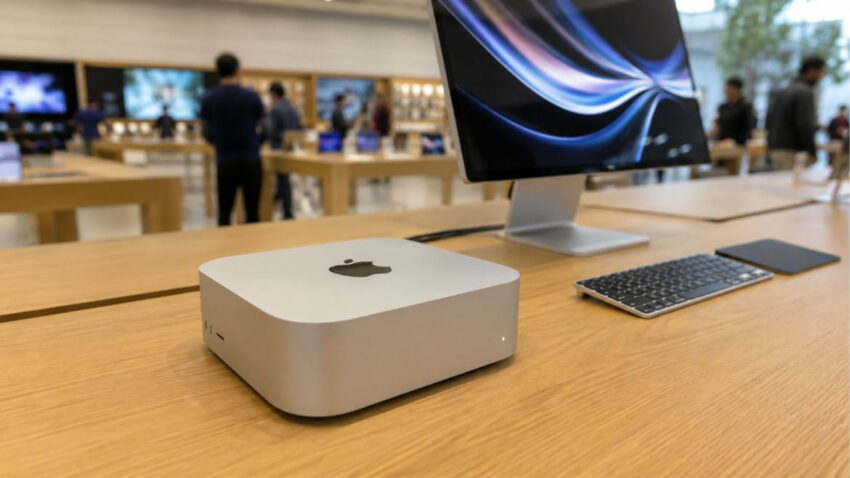
Apple pushed its desktop computers deeper into the AI race Tuesday. The company unveiled new Mac Mini and Mac Studio models designed to run local AI models on their own hardware, not in a distant data center. Apple paired the refresh with two new chips, the M6 and the M5 Ultra, and pointed both at developers who want to keep their work off the cloud.
The timing stands out. Apple revealed the machines just weeks before it plans to show off new iPhone models. The move underscores how much the company now leans on desktops to prove the strength of its processors.
Developers have already turned compact Macs into AI workhorses. Many run autonomous agents on a dedicated Mac Mini instead of renting cloud time. Software, such as OpenClaw, has fueled that habit, and researchers often reach for the Mac Studio to train and test local AI models.
M6 headlines the new Mac Mini
The Mac Mini now ships with a choice of two processors, the M6 or the M5 Pro.
The M6 marks a milestone. Apple built the chip on a 2-nanometer process from Taiwan Semiconductor Manufacturing Co., its first desktop silicon at that scale. The chip packs a 12-core CPU, a 12-core GPU, and what Apple calls a Dual 16-core Neural Engine.
Apple says the M6 delivers up to four times the AI performance of the M4 it replaces. The company also claims 40% faster processing, plus double the graphics and storage speed. The M6 supports up to 32GB of unified memory and 170GB per second of bandwidth.
The M5 Pro option climbs higher for people who lean on local AI models every day. It stretches memory to 64GB and bandwidth to 307GB per second. Apple says that version handles large language model prompts up to 8.5 times faster than the older M2 Pro Mac Mini, and up to four times faster than the M4 Pro model.
“With these frameworks and new chips, developers can run and fine-tune large AI models locally on their Mac,” Apple said in its press release.
Apple wants the Mac to double as an AI agent

That message sits at the core of Apple’s plan.
The small Mac Mini can hum away in a corner as an always-on box. Developers like that setup for agents that tap local AI models around the clock. Local computing also trims recurring cloud bills, keeps sensitive data in-house, and lets builders test open models without shipping every prompt to an outside server.
Apple has shaped its silicon around that goal. Its unified memory lets the CPU, GPU, and Neural Engine pull from one pool, which helps when big models need room. The new Mac Mini adds Wi-Fi 7, Bluetooth 6, and 2.5Gb Ethernet, with 10Gb Ethernet as an upgrade. The M5 Pro model also gains Thunderbolt 5, so users can link several Macs for heavier jobs and bigger local AI models.
Mac Studio chases much larger workloads

Apple aimed the Mac Studio at the biggest local AI models a desk can hold. The machine now stands as Apple’s most powerful computer without a built-in screen, a role it inherited after Apple dropped the Mac Pro this year.
The new lineup carries either the M5 Max or the fresh M5 Ultra. The M5 Max brings an 18-core CPU, up to a 40-core GPU, and as much as 128GB of unified memory. That headroom suits creators who wrangle heavy local AI models.
The M5 Ultra climbs into another class. Apple offers up to 36 CPU cores, 80 GPU cores, and a hefty 512GB of unified memory. Bandwidth reaches 1.2TB per second. The company says the chip hits up to 4.3 times the peak AI compute of the M3 Ultra, enough to hold enormous local AI models on one machine.
Apple also opened the door to clusters. Thunderbolt 5 and remote direct memory access let several Mac Studio units act as one system. Apple says a four-machine cluster can deliver up to three times the AI inference of a lone unit. That pitch could draw researchers who crave shared memory but want an alternative to costly GPU servers for local AI models.
More power brings steeper prices
The upgrades cost more. The M6 Mac Mini starts at $899, up from $799, while the M5 Pro version opens at $1,699. Apple had already raised the entry Mac Mini over the summer and blamed rising memory costs.
The Mac Studio with the M5 Max starts at $2,499, matching the prior price. The M5 Ultra version begins at $5,499, a step up from the $5,299 Apple charged for the older M3 Ultra build.
Preorders open now, and Apple plans to ship the machines Sept. 22. The 512GB Mac Studio follows in late October.
The strategy now reads clearly. Apple no longer wants the Mac to reach AI tools elsewhere. It wants the Mac to become the machine that runs local AI models itself.
What do you think? Can Apple’s new desktops make local, on-device AI a real rival to the cloud, or will steep price tags keep most buyers away? Please share your views below.