

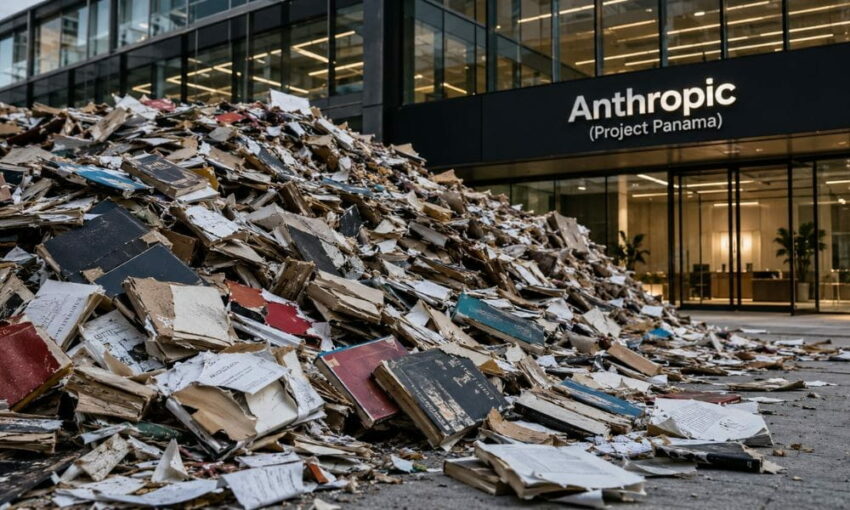
A secret Anthropic effort to buy, slice apart, and digitize millions of printed books has burst into public view, and the timing stings for a company still defending how it built Claude. Court records refer to the operation as Project Panama.
Unsealed filings in a copyright class action show the plan took shape in early 2024. Anthropic wanted a private library of professionally edited writing rather than text scraped from the open web.
One internal planning document stated the goal plainly. “Project Panama is our effort to destructively scan all the books in the world,” it said.
Another line pushed for secrecy. “We don’t want it to be known that we are working on this.”
Why did Anthropic chase physical books?
Company researchers prized books as a source of clean, human-written language. Internal notes argued that books could teach Claude “how to write well” instead of copying “low quality internet speak” from the web.
That worry carries weight across the industry. Developers fear model collapse, a slow decay that sets in when systems train on their own machine-made output. Older books predate that flood. They offer long arguments, edited prose, and narrative structure that ordinary web pages often lack. Anthropic executives bet that richer source text would sharpen Claude against its rivals.
Anthropic hired Tom Turvey in February 2024 to grow its book pipeline. Turvey had earlier worked on partnerships for Google’s book-scanning project. His team briefly weighed licensing deals with major publishers, yet those talks did not conclude.
So Project Panama turned to paper.
Inside the industrial scanning line
The operation ran like a factory, not a library desk. Anthropic bought millions of used titles in bulk, often secondhand, from sellers such as Better World Books and Britain’s World of Books. Contractors then stripped the bindings with hydraulic cutters and fed loose pages through high-speed scanners.
The machines copied each page into a searchable file. The physical copies did not survive. Workers sent the shredded paper off for recycling.
The scale stunned observers. One vendor proposal cited capacity to convert 500,000 to 2 million books within six months. The final tally stays partly redacted, though court findings confirm Anthropic digitized millions of volumes. The Project Panama corpus stayed private, closed to readers, libraries, and the authors themselves.
The piracy that came first
Yet Project Panama was the cleaner chapter. Before it, Anthropic staff had already pulled millions of digital books from illegal shadow libraries.
The court found the company grabbed more than 5 million books from Library Genesis, or LibGen, in 2021. It later took at least 2 million more from Pirate Library Mirror in 2022. Together, those hauls topped 7 million pirated files.
Co-founder Ben Mann shared a link to Pirate Library Mirror with colleagues once it appeared.
“Just in time!!!” Mann wrote, according to the filings.
A judge splits the difference
Project Panama surfaced through Bartz v. Anthropic, a suit led by novelist Andrea Bartz and authors Charles Graeber and Kirk Wallace Johnson. The Washington Post first reported the effort in January.
Judge William Alsup drew a sharp line in June 2025. He ruled that training Claude on lawfully purchased books qualified as fair use. He decided the same about converting those bought books into digital files. Buying and scanning, in his view, transformed the work.
Piracy earned no such shield. Alsup found that stockpiling pirated copies in a central library broke the law, and that finding steered Anthropic toward a costly trial.
A record settlement, and a warning shot
Anthropic chose to settle instead. Judge Araceli Martinez-Olguin granted final approval on July 20. The deal covers roughly 482,000 works and pays about $3,000 for each qualifying title.
“It is the largest known copyright recovery in history,” plaintiffs’ attorney Justin Nelson said. Anthropic already paid $300 million into the fund, and more installments come due on the deal’s anniversaries.
For authors, though, Project Panama reframed the entire dispute, because it showed how deliberately the company hunted their pages.
Anthropic still stresses the legal split. “The issue we settled on was about how some materials were acquired, not whether we could use them to develop [AI],” deputy general counsel Aparna Sridhar said. The company must also destroy its pirated LibGen and Pirate Library Mirror files.
The fight reaches well past Project Panama. OpenAI, Meta, Google, and Microsoft all face similar copyright claims. Alsup has since retired, and his ruling binds no other court, so rival judges may land elsewhere.
Money, meanwhile, keeps flowing to Anthropic. The company hit a $965 billion valuation in May and reported a $47 billion revenue run rate. Project Panama shows the raw appetite behind those numbers. Courts now must weigh not just how firms use creative work, but how they seize it, and that question could reshape every training library built after Project Panama.
What do you think? Should AI developers license books directly from writers and publishers before feeding them to a model, even when they buy physical copies first? Please share your views below.