

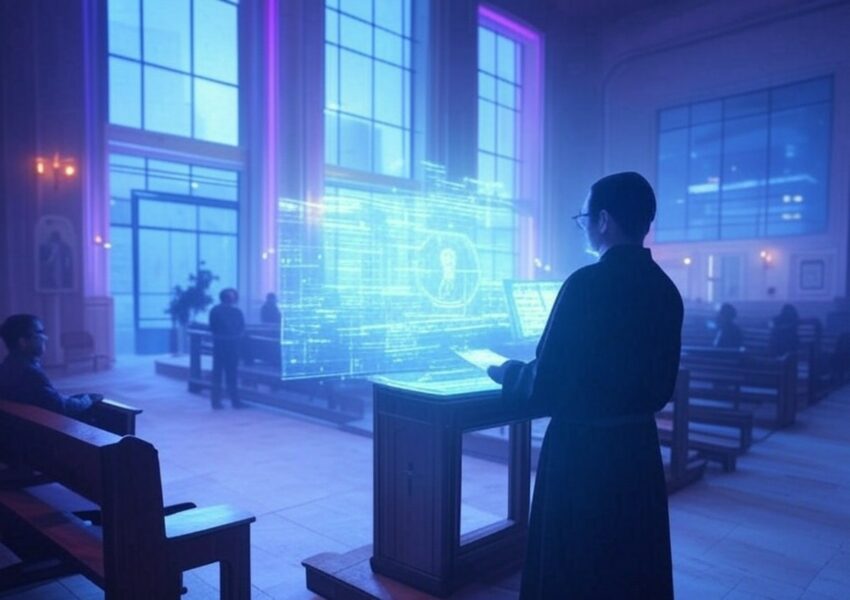
The Finnish Lutheran Church has launched a pioneering artificial intelligence initiative that experts call one of the most ambitious religious digital transformations in Europe. Church leaders hope the technology will revitalize membership, engage younger generations and modernize ministry approaches while preserving core Lutheran values.
Technology meets tradition in religious innovation
Confronting steady declines in attendance and engagement, particularly among young Finns, church leadership embarked on a comprehensive digital strategy that incorporates artificial intelligence across both spiritual and operational functions.
“We’re witnessing profound shifts in how people seek spiritual connection,” said Rev. Kari Nieminen, church spokesperson. “Our AI implementation isn’t replacing human ministry—it’s providing digital tools that enhance our ability to meet people where they are.”
The church’s digital transformation represents a growing trend of religious institutions adopting technology solutions to address contemporary challenges while maintaining theological integrity.
AI-enhanced spiritual guidance transforms ministry
The Finnish initiative employs advanced natural language processing to analyze centuries of Lutheran theological texts, helping clergy develop relevant sermons that connect traditional teachings with contemporary issues.
The church also developed an AI-powered spiritual assistant available through their digital platforms that provides immediate theological guidance, personalized devotional content and prayer support. The system continuously improves through user feedback while adhering to Lutheran doctrine.
“For digital natives, interacting with AI often serves as their first meaningful connection to our faith community,” Nieminen noted. “It creates a bridge between modern technological expectations and timeless spiritual questions.”
Religious technology experts believe these innovations could reshape how faith communities approach evangelism and spiritual formation in increasingly secular European societies.
Administrative efficiency redirects resources to community needs
Beyond spiritual applications, the church’s AI systems have transformed administrative operations that serve thousands of members across Finland. Automated scheduling, donation processing and event management have significantly reduced organizational overhead.
Internal assessments reveal a 30% reduction in administrative costs through AI implementation, with savings redirected toward community outreach and support programs that directly impact vulnerable populations.
“Our technological efficiency directly translates to enhanced ministry capacity,” explained Nieminen. “Every administrative hour saved becomes an hour available for meaningful human connection.”
Church financial analysts predict that operational improvements could save millions of euros annually while increasing service capacity across Finland’s Lutheran parishes.
Ethical frameworks guide responsible AI ministry
The integration of advanced technology into sacred traditions has prompted careful consideration of potential risks. Critics question whether AI might oversimplify complex theological concepts or diminish the personal nature of pastoral care.
To address these concerns, the church established an interdisciplinary ethics committee comprising theologians, technology experts, and ethicists to provide ongoing oversight of all AI implementations.
“The challenge lies in ensuring technology amplifies rather than replaces human spiritual discernment,” said Dr. Liisa Korhonen, religious studies professor at the University of Helsinki. “The church’s commitment to ethical guidelines demonstrates remarkable foresight.”
These governance structures include regular system audits, transparency reporting and community feedback mechanisms that maintain alignment with core Lutheran values while embracing technological innovation.
Digital connection strengthens religious community
Perhaps the most promising aspect of the church’s digital strategy is its potential to foster stronger community bonds despite geographical dispersion and modern isolation. The church’s AI systems deliver personalized ministry opportunities based on individual interests, needs, and past participation.
Members receive targeted information about local worship services, small groups, volunteer opportunities and support resources tailored to their specific circumstances. This personalization has measurably increased engagement across age demographics.
“Effective technology should strengthen human connection, not replace it,” Nieminen emphasized. “Our AI systems identify needs and facilitate meaningful in-person interactions that might otherwise never occur.”
Early data shows participation increases of 15% among members under 35, a demographic previously showing steady declines in religious engagement.
Global religious bodies monitor Finnish innovation
Religious organizations worldwide are closely watching Finland’s technological experiment as they face similar challenges of declining relevance and engagement. American, British, and European religious institutions have sent delegations to study the Finnish approach.
Research indicates that over 40% of major religious organizations globally are exploring similar digital transformations, with the Finnish Lutheran model potentially influencing implementation strategies across denominations and faiths.
“Religious institutions have historically adapted to cultural shifts,” noted Korhonen. “The Finnish approach demonstrates how churches can embrace digital transformation while preserving theological authenticity.”
Religious technology conferences have featured the Finnish case study prominently, suggesting broader implications for faith communities globally.
Economic impact and generational bridge
The church’s AI integration presents significant economic benefits amid financial pressures facing many religious institutions. Streamlined operations and reduced overhead create sustainable ministry models that maximize limited resources.
The digital strategy also addresses critical generational divides by providing technology-centered engagement for younger members while using those same systems to better serve older congregants through enhanced support services and communication.
“Our modernization simultaneously addresses financial sustainability and generational inclusion,” said Nieminen. “We’re creating pathways for different generations to connect through shared faith despite different technological comfort levels.”
Economic analysts project the approach could serve as a model for religious institutional sustainability in secularizing societies where traditional funding models face increasing challenges.
Future religious technology on the horizon
Current implementations represent only initial phases of the church’s long-term vision. Future developments include predictive analytics to identify community needs, virtual reality worship experiences for those unable to attend physically, and AI-assisted counseling support for clergy serving large parishes.
“We’re at the beginning of understanding how technology can enhance ministry,” said Nieminen. “The coming years will reveal new possibilities for serving our community through thoughtful digital integration.”
Technology roadmaps indicate potential expansion into augmented reality biblical experiences, AI-enhanced community service coordination, and personalized spiritual formation pathways tailored to individual faith journeys.
A new model for religious relevance
The Finnish Lutheran Church’s embrace of artificial intelligence signifies a potential turning point for religious institutions navigating digital transformation. By integrating AI across pastoral and administrative functions, the church has created new engagement pathways while honoring traditional values.
As digital technology reshapes society, Finland’s experience offers valuable insights for institutions balancing heritage and innovation. The approach demonstrates how religious organizations can maintain spiritual authenticity while embracing technological tools that enhance their fundamental mission of building community and providing spiritual guidance.
In an era of rapid technological advancement, the Finnish Lutheran Church provides a compelling case study of faith institutions adapting to change while preserving their essential purpose.
How do you view this recent Finnish church initiative? Please share your views below.